





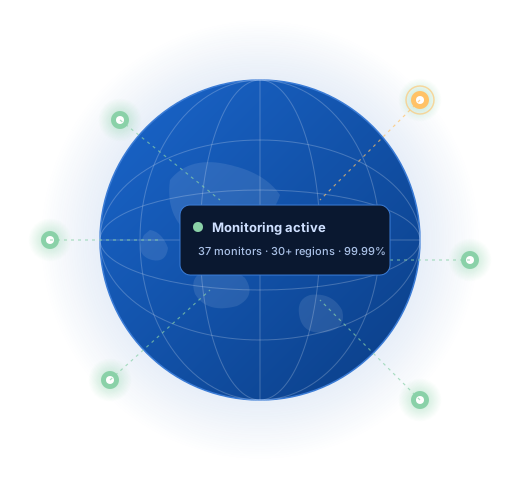
Organizations Worldwide
Platform Uptime SLA
Global Monitoring Locations
Website Monitoring Leader
API monitoring is the continuous, automated practice of validating API endpoints for availability, response time, and data correctness — running synthetic requests from outside your infrastructure and alerting your team the moment any of those break. Unlike one-off tests, monitoring runs 24/7 on a fixed cadence from multiple global locations.
Each protocol has its own deep-dive page with setup guides, code samples, and use cases. Or just start a trial and we’ll auto-detect what you’re running.
JSON validation, schema assertions, multi-step chaining, OAuth/JWT. The workhorse spoke for any team running HTTP REST APIs.
WSDL import, XPath validation, SOAP 1.1/1.2 support, WS-Security. Built for enterprise, financial, and healthcare APIs.
Query-aware monitoring. Inspects the errors array and response data, since GraphQL returns 200 even on failure.
Import Insomnia v4 exports with full request details, environment variables, and auth configs preserved.
Looking for OAuth, JWT, mTLS, or other auth schemes? Every protocol above supports them — see the full auth matrix →
External references: learn more about REST, SOAP, GraphQL, and the API pattern itself.
Six things teams tell us they couldn’t do as cleanly with Datadog, Pingdom, Uptrends, or Postman Monitors.
Run distributed checks from North America, Europe, Asia-Pacific, and South America. Catch the regional CDN issue, the DNS propagation gap, the geo-routing fault.
Contractual uptime backed by 25+ years of monitoring infrastructure. Your monitoring tool itself never becomes the single point of failure.
Chain login → fetch → mutate → confirm into one monitor. Pass tokens between steps, abort on first error, capture step-level logs.
Route alerts directly into your incident tools — with diagnostic context, response payloads, and trace IDs in the first notification.
Drop a lightweight agent inside your VPC to monitor internal microservices. Outbound connection only — no inbound firewall rules.
Trigger monitor runs from GitHub Actions, Jenkins, Azure DevOps. Gate releases on assertion results, latency, or availability.
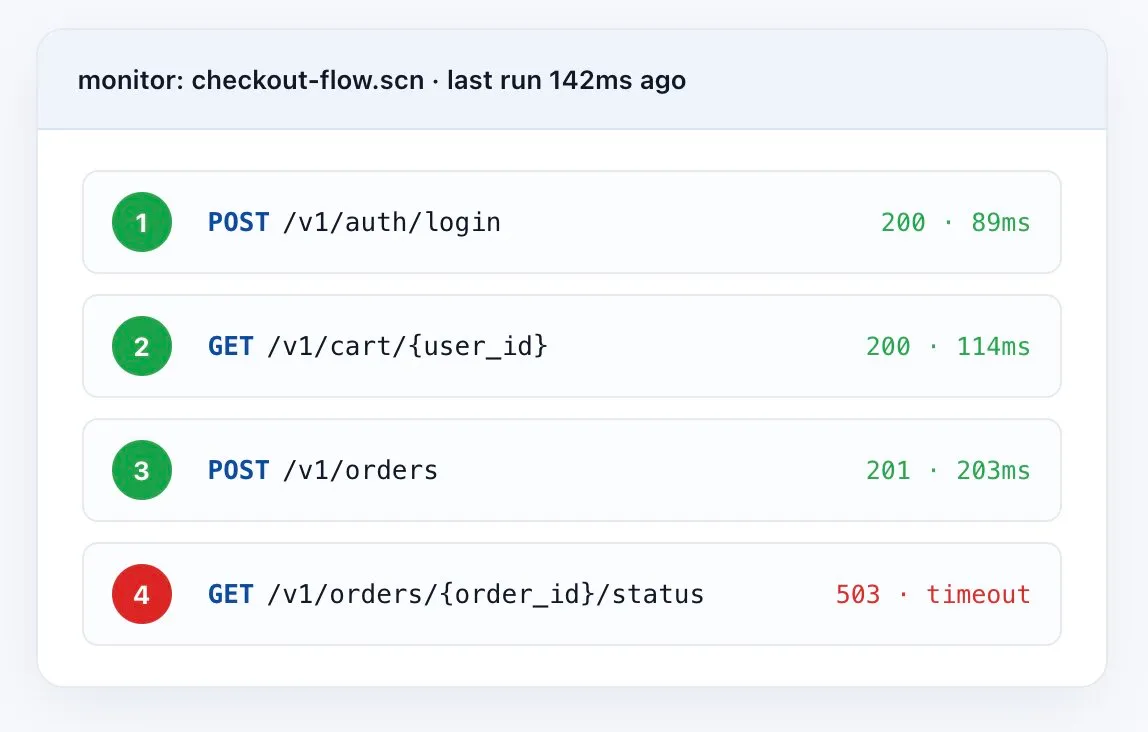
A working /health check doesn’t prove your business logic still works. Chain real sequences — auth → fetch → mutate → verify — and validate every step. The moment the chain breaks, you know exactly where, why, and what the response looked like.
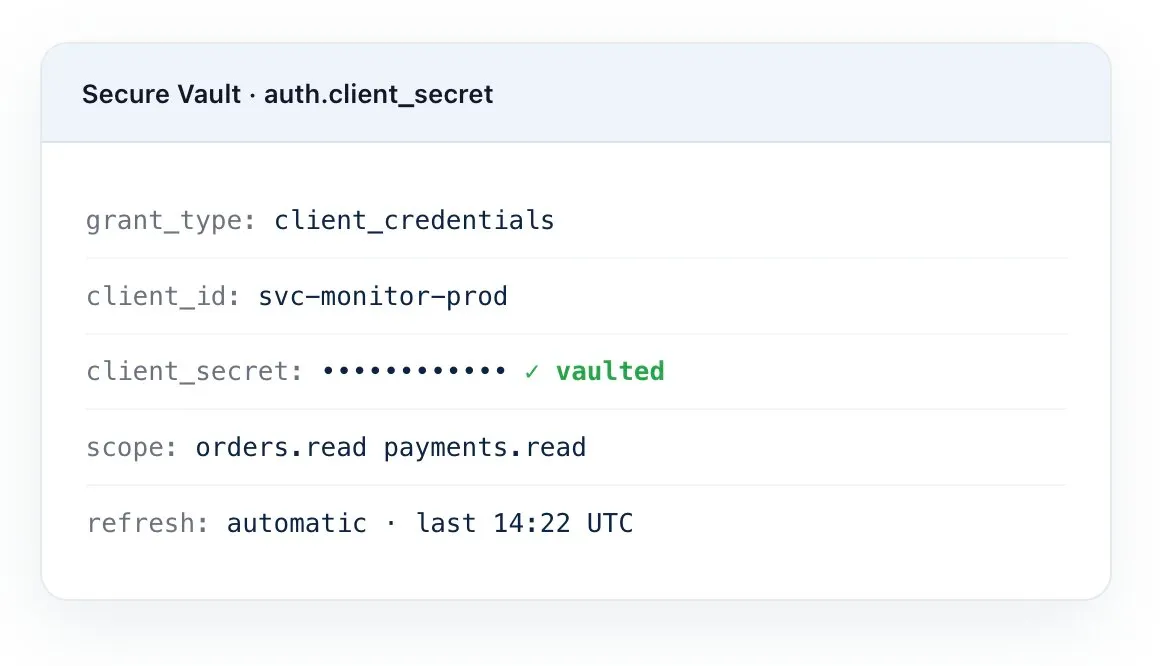
Production APIs don’t live behind one auth method. Dotcom-Monitor natively supports the full spread — and masks every secret in Secure Vault, so credentials never leak into logs or exported scripts.
Dotcom-Monitor operates its own monitoring infrastructure across 30+ locations on six continents — plus Private Agents you can deploy inside your VPC, behind firewalls, or on-prem to monitor internal microservices.
That means you catch the regional outage, the DNS propagation gap, the CDN misroute — not just the global ones.
Global locations
Continents covered
Minimum check interval
For behind-firewall

Configure REST, SOAP, or GraphQL endpoints, headers, JSONPath/XPath assertions, and auth. Or import a Postman or Insomnia collection directly.
Run checks at 1-, 3-, 5-, or 15-minute intervals from 30+ global locations across North America, Europe, Asia-Pacific, and South America.
Track availability %, P95/P99 response times, TTFB, DNS time, and error rates by HTTP status code across every monitored endpoint.
Get alerted via email, SMS, Slack, PagerDuty, or Teams within seconds — with response time, status code, and validation failures attached.
APIs power payments, authentication, inventory, financial transactions, and SaaS integrations. When they fail — even briefly — the impact is immediate.
Without proactive monitoring, teams rely on customer reports to detect failures — adding 30–60 minutes to detection alone. Continuous synthetic monitoring shortens detection to under 60 seconds, enabling faster root-cause isolation.
For B2B SaaS, FinTech, and healthcare, API downtime triggers SLA penalties, compliance violations, and audit findings. Documented uptime evidence is what defends SLA adherence in renewal conversations.
An e-commerce platform processing 100 orders/min at $50/order loses $25,000 per 5-minute outage. A failed checkout, payment authorization, or auth call halts conversion immediately.
Modern apps depend on Stripe, Auth0, Okta, Twilio. Even when your infrastructure is healthy, a degraded upstream can break checkout, login, and data sync. Monitor third-party endpoints to isolate fault origins.
A performance engineer will show you how to set up your first monitor in your environment — no sales pitch, just a working monitor by the end of the call. Direct calendar booking, no gatekeeping.
A reference for buyers weighing options. We try to be fair — every tool has a job; this is where we fit.
Capability | Dotcom-Monitor | Postman Monitors | Pingdom / Uptime-only | Datadog Synthetics |
|---|---|---|---|---|
Multi-step API chains with variable passing | Full | Partial | ||
JSON / XML / XPath payload assertions | Limited | |||
OAuth 2.0 + JWT auto-refresh | Manual | Limited | ||
SOAP / WSDL / WS-Security | Partial | |||
Private Agents (behind firewall) | ||||
30+ global monitoring locations | Limited | |||
Import Postman / Insomnia collections | (Postman) | |||
CI/CD gate-blocking via API | Partial | |||
Free trial | 30 days, full features | Paid plans | 14 days | 14 days |
Built a full checkout-flow monitor with EveryStep Recorder that runs every 15 minutes — adds items, applies coupons, validates pricing, submits with a declined card to test payment logic end-to-end.
Millions of monthly visitors across 50+ countries. Implemented Dotcom-Monitor synthetic + performance testing to safeguard checkout under peak load.
All reviews sourced from Capterra verified reviews. Ratings as of October 2026.
Every plan includes REST API monitoring, synthetic checks, multi-step transactions, and uptime reporting. No hidden fees.
Free
Free Forever
$0
Most popular
Subscriptions
Starting at
$19
.99 /mo
Enterprise
Custom Pricing
Let’s talk
Monitor internal and third-party API dependencies to keep integrations returning correct data on time. Detect partner-API degradation before it cascades.
Track payment gateways (Stripe, PayPal), inventory systems, and shipping endpoints. A 5-min outage at checkout can cost tens of thousands during peak.
Ensure financial APIs meet regulatory security and sub-second latency. Monitor transaction processing, KYC, and banking integrations to avoid failed transactions.
Monitor EHR APIs, insurance portals, and telemedicine platforms. Keep HIPAA-compliant data exchange endpoints available and responsive.
Validate cross-department API integrations — CRM, ERP, HR, communications. Detect cross-system failures before they disrupt internal workflows.
Monitor content delivery APIs, streaming endpoints, and rights-management services. Validate that downstream consumers see correct data globally.
Seven things every team running production APIs should do — independent of which tool they pick.
A single location can’t detect regional DNS failures, CDN misconfigurations, or geo-routing issues. Use at least 5 distributed locations.
An HTTP 200 doesn’t guarantee correctness. Use JSONPath or XPath assertions to verify response bodies have the expected structure and content.
Static thresholds trigger false positives. Establish per-endpoint baselines, then alert at 2× the P95 response time.
Token expiration, OAuth refresh failures, and cert rotation are common causes of outages. Include auth steps so credential issues get caught early.
A single endpoint may pass while the full transaction fails. Multi-step monitors catch session, sequencing, and data-dependency failures.
Payment gateways, identity providers, and shipping APIs degrade independently. Dedicated monitors isolate whether failures are internal or external.
Run post-deploy synthetic checks. Automated smoke tests catch schema changes, missing fields, and regressions before they reach users.
API monitoring is the continuous, automated practice of validating API endpoints for availability, response time, and data correctness from outside your infrastructure. Unlike one-off tests, monitoring runs 24/7 from multiple global locations on a fixed cadence — and alerts you the second any of those break.
For an explanation of monitoring types, key metrics, and implementation steps, read our guide to API monitoring.
Yes. Dotcom-Monitor’s web API monitoring checks the REST, SOAP, and GraphQL endpoints behind your website, including authentication, checkout, and third-party integrations. It validates availability, response times, and response content from multiple monitoring locations.
If you need a website monitoring API for automation, Dotcom-Monitor’s Web API lets you create and configure monitors, while its XML Reporting Service (XRS) provides monitoring results for your own dashboards and tools. Learn more about the Dotcom-Monitor API and reporting integrations.
API Key, Basic Auth, OAuth 2.0 (Client Credentials, Authorization Code, Refresh Token), JWT with automatic refresh, Bearer Token, AWS Signature v4, NTLM, Kerberos, mTLS, and custom headers. Secrets are masked through the Secure Vault.
Yes. Multi-step monitors pass tokens, IDs, and dynamic values between steps, validate each step independently, and abort the chain at the first failure with full per-step request/response logs.
Yes. Deploy lightweight Private Agents inside your network — they initiate outbound connections, so no inbound firewall rules are required.
Uptime tools mark you green when a 200 comes back. We validate the actual response — JSON schema, headers, payload contents, latency percentiles, downstream chain success — so partial failures (the 200-but-broken kind) get caught.
API monitoring tests from outside (the user’s perspective). APM tracks internal behavior — code, database, server. Mature teams run both: synthetic for customer-facing checks, APM for root-cause debugging.
Yes. Trigger monitor runs via API from GitHub Actions, Jenkins, Azure DevOps. Gate the deploy on availability, latency, or assertion results to stop bad builds from reaching production.
As often as every minute per endpoint. We recommend 1-minute intervals for critical paths (login, checkout, payment) and 5- or 15-minute intervals for lower-priority endpoints.
Availability % (target 99.9%+), response time (P95/P99), error rate (4xx + 5xx), TTFB, DNS resolution time, SSL handshake time, and throughput. Plus payload validation — the metric uptime tools miss entirely.
For revenue-impacting APIs (login, payment, checkout), every minute. For less critical endpoints, every 5 or 15 minutes is fine. The right cadence balances detection time against check-volume cost.
Testing happens in development and CI to verify endpoints behave correctly before release. Monitoring runs continuously in production, tracking real-world availability, latency, and response accuracy over time. Testing catches bugs before deploy; monitoring catches failures, regressions, and degradation after deploy.
No. API monitoring tests from outside (the user perspective). APM tracks internal behavior — code execution, database queries, server resources. Mature teams run both: synthetic for customer-facing checks, APM for root-cause debugging.
Time to First Byte measures the elapsed time from sending a request to receiving the first byte of response. From a synthetic client this includes DNS, TCP, TLS, and server processing — but not the time to transfer the body. High response time with low TTFB points to a large payload; high TTFB points to slow server processing.
For global apps, at least 5 distributed locations covering your primary user regions. Typical baseline: North America East, North America West, Western Europe, Asia-Pacific, South America. This catches regional CDN issues, DNS propagation gaps, and geo-routing anomalies that single-location monitoring misses entirely.
30-day free trial. No credit card. Full platform access. Live in under five minutes.