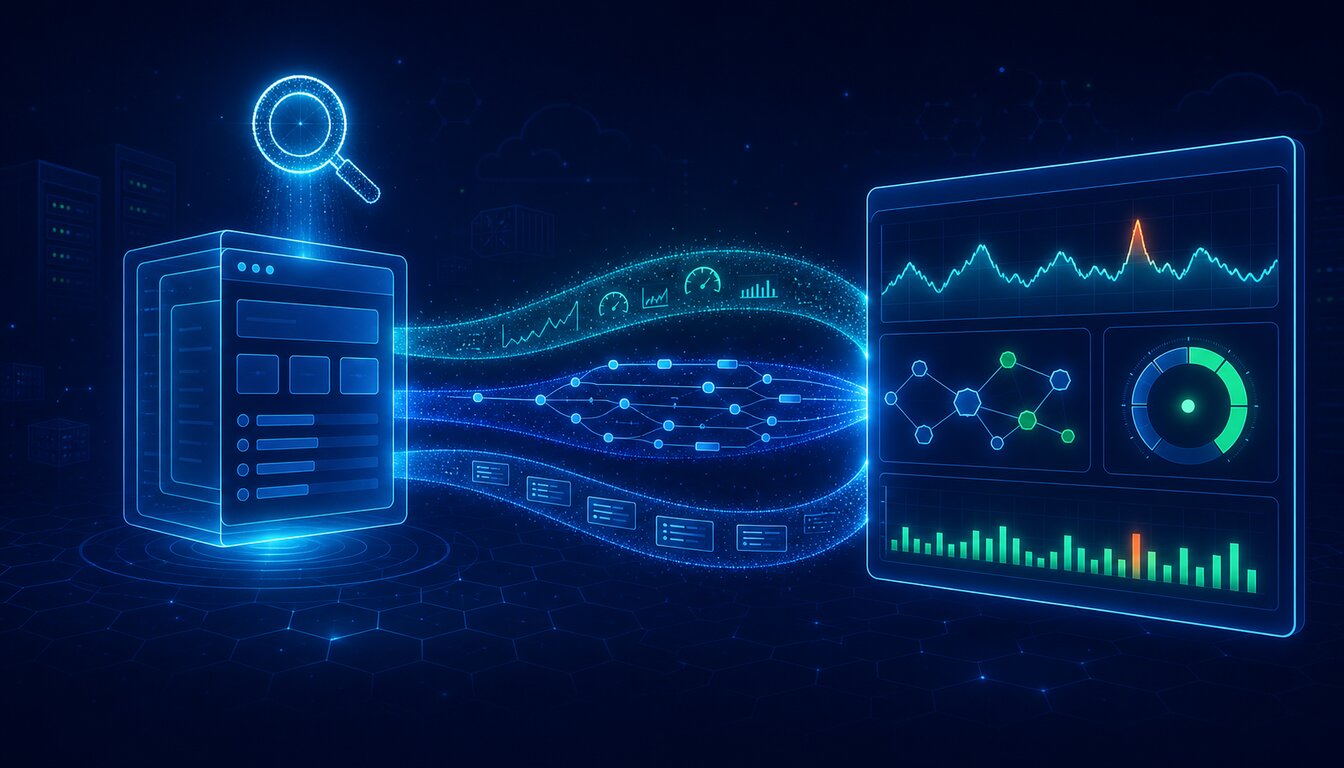
Application Performance Monitoring (APM) is the practice of collecting, correlating, and analyzing telemetry data (metrics, traces, logs, and events) from running software to detect performance regressions, locate root causes, and verify service-level objectives. An APM tool instruments applications either through language-specific agents, SDKs, or open standards like OpenTelemetry, then ships that data to a backend that surfaces it through dashboards, alerts, and trace-level diagnostics.
APM, Application Performance Management, and Application Portfolio Management are not the Same
Three different disciplines share the acronym APM. Disambiguating them upfront prevents confusion when reading vendor documentation.
Application performance monitoring is the measurement layer: collecting telemetry from a running application and surfacing it as metrics, traces, and logs. It answers is this application healthy right now, and if not, where is the problem?
Application performance management is the broader discipline: defining SLOs, building performance budgets, running load tests, instrumenting code, operating the monitoring stack, and acting on what it surfaces. Monitoring is one component of management.
Application portfolio management sits at the business architecture layer. It tracks the full inventory of applications an organization runs and decides which to invest in, modernize, consolidate, or retire. It uses monitoring data as input but is not a performance discipline per se.
When this article uses “APM” without qualification, it refers to application performance monitoring.
Application Performance Monitoring vs. Observability
APM is a subset of observability. APM focuses on application-layer performance: response times, throughput, error rates, transaction flow. Observability is the broader practice of being able to ask arbitrary questions about a system’s internal state from the telemetry it emits, including infrastructure, network, and business-event data.
In practical terms:
- APM tools tell you the /checkout endpoint’s p95 latency rose from 180 ms to 1.4 s after the 14:02 deploy.
- An observability stack lets you correlate that with a Kubernetes node memory pressure event, a Postgres lock-wait spike, and a feature-flag rollout that happened in the same window.
Modern APM platforms (Datadog APM, New Relic, Dynatrace, Elastic Observability, Grafana Cloud, Splunk Observability Cloud) have absorbed enough of the broader observability surface that the line has blurred. The cleanest mental model: observability is the goal, APM is the application-focused slice of the data needed to reach it.
How Application Performance Monitoring Works
APM operates in four stages: instrumentation, collection, transmission, and correlation.
1. Instrumentation
Instrumentation adds measurement points to application code so it emits telemetry. There are three common approaches:
- Auto-instrumentation agents. Language-specific runtime agents (Java’s bytecode instrumentation, .NET profilers, the Python or Node.js OpenTelemetry auto-instrumentation libraries) hook into framework entry points (HTTP handlers, database drivers, message queue clients) without code changes.
- Manual instrumentation via SDK. Developers call APM or OpenTelemetry SDKs directly to start and stop spans, attach attributes, and emit custom metrics. Required for business-specific transactions the agent does not recognize.
- eBPF and agentless collection. Kernel-level probes capture syscall, network, and process data without modifying the application. Useful for environments where agent installation is restricted (compliance-bound workloads, third-party services).
OpenTelemetry (OTel) is the de facto open standard for instrumentation across all three approaches. It defines the wire protocol (OTLP), the semantic conventions for span and metric naming, and language SDKs in Java, Go, Python, Node.js, .NET, Ruby, PHP, and others. Erlang and Elixir are covered by the official opentelemetry-erlang library. Rust traces are stable; logs and metrics are progressing. Swift is available as a community-maintained SDK.
2. Collection
The instrumented application emits three primary signal types:
- Metrics: numeric measurements at a point in time (request count, latency histogram, CPU usage).
- Traces: ordered sets of spans that represent the path of a single request across services.
- Logs: timestamped text records, ideally structured as JSON, with trace and span IDs for correlation.
Newer signal types include continuous profiles (CPU, memory, and lock profiles sampled in production) and Real User Monitoring (RUM) events emitted by JavaScript or mobile SDKs running in the user’s browser or device. The OpenTelemetry Profiles signal was accepted as an OTEP in 2024 and is still maturing; backend support is partial as of 2025–2026.
3. Transmission
Telemetry flows from the application to a backend through one of two routes:
- Direct export from the agent or SDK to the APM vendor’s ingestion endpoint over OTLP, HTTP, or a proprietary protocol.
- Via a collector (the OpenTelemetry Collector, or a vendor-specific distribution like the Datadog Agent or the Splunk Distribution of OpenTelemetry Collector) that batches, filters, samples, and routes data. Log-oriented forwarders like Fluent Bit and Vector can handle logs and metrics alongside the OTel Collector for trace data. Collectors decouple instrumentation from the backend, which makes it possible to switch vendors without re-instrumenting code.
4. Correlation
The backend joins signals on identifiers (trace ID, span ID, service name, host, container ID, user ID) so an investigation that starts from any signal can pivot to the others. A typical workflow: an alert fires on increased error rate → click through to the affected service’s traces → drill into a representative failing trace → jump from the slow span to its logs → confirm the offending database query → check the database host’s metrics. This pivot path is what separates an APM platform from a collection of point tools.
Core Components of an APM Stack
A complete APM deployment includes:
| Component | Purpose |
|---|---|
| Agents / SDKs / OTel libraries | Instrument the application and emit telemetry |
| Collector | Batch, filter, sample, and route telemetry |
| Metrics backend | Time-series storage, alerting, dashboards |
| Trace backend | Span storage, dependency mapping, latency analysis |
| Log backend | Indexed log storage with trace correlation |
| RUM and synthetic monitoring | Measure performance from the user perspective |
| Alerting and incident response integration | Route signals to on-call (PagerDuty, Opsgenie, Slack) |
| Profiler | Continuous CPU and memory profiling in production |
How to cover the synthetic monitoring with Dotcom-Monitor. Dotcom-Monitor has four synthetic monitoring products that share one alerting and reporting workflow. Use BrowserView for single-page load timing across 40+ browser and device combinations. Use UserView for multi-step transaction flows (login, search, checkout). Use WebView for REST, SOAP, and GraphQL API monitoring. Use ServerView for TCP, DNS, SMTP, FTP, ICMP, and other network-protocol checks. For internal applications behind a firewall, install the Private Agent on a server inside the network. It is a single binary that initiates outbound connections to the platform, so no inbound firewall rules are required and internal endpoints stay private.
APM Metrics that Matter
These are the metrics most teams instrument and alert on. Definitions are aligned with OpenTelemetry semantic conventions where applicable.
| Metric | Definition |
|---|---|
| Response time / latency | Wall-clock time from request received to response sent. Track p50, p95, p99, and p99.9 separately; averages hide tail latency. |
| Throughput | Requests processed per unit time, typically requests per second (RPS) or per minute (RPM). |
| Error rate | Fraction of requests that returned a 5xx, threw an exception, or violated a business invariant. Expressed as a percentage. |
| Apdex score | User-satisfaction index between 0 and 1 derived from a configurable latency threshold T. Apdex = (satisfied + tolerating/2) / total. Considered legacy by most SRE teams today, who prefer explicit SLI/SLO latency targets (e.g., p99 < 500 ms over a 28-day window); still surfaced by AppDynamics, New Relic, and a few others. |
| Saturation | How full a resource is (CPU, memory, connection pool, queue depth). One of Google’s four golden signals. |
| CPU and memory utilization | Per-process and per-container resource consumption. |
| Garbage collection metrics | GC pause duration, frequency, and heap size for JVM, .NET, Go, and Node.js workloads. |
| Database query metrics | Query latency, rows examined, lock wait time, slow-query count. |
| Queue depth and consumer lag | For Kafka, RabbitMQ, SQS, and similar systems. Lag is a leading indicator of cascading slowness. |
| Cold start duration | Specific to serverless (AWS Lambda, Azure Functions, Google Cloud Run). |
| MTTD, MTTR, MTBF | Mean Time To Detect, Mean Time To Recovery, Mean Time Between Failures. Operational health metrics, tracked alongside application metrics. |
| SLI / SLO / error budget | Service-Level Indicators, the Objectives set against them, and the budget consumed when the SLI breaches its target. |
How to capture these metrics without instrumenting code. Several rows above can be measured from outside the application with no agent or SDK. A synthetic check in Dotcom-Monitor returns response time with p50, p95, and p99 breakdowns, error rate by HTTP status code, Time to First Byte (TTFB), DNS resolution time, TLS handshake duration, and full waterfall timings per request. Data is retained up to three years on the Enterprise plan, which is long enough to compute year-over-year SLI baselines without exporting to a separate time-series database.
The Google SRE book defines the four golden signals as latency, traffic, errors, and saturation. The RED method (Rate, Errors, Duration) and USE method (Utilization, Saturation, Errors) are widely adopted frameworks that group these into manageable dashboards.
Benefits of APM
Technical benefits (engineering)
- Faster root-cause analysis. Distributed traces collapse multi-service investigations from hours to minutes by exposing the exact span where latency or errors originate.
- Production-safe debugging. Continuous profilers and structured logs make it possible to diagnose issues in production without attaching a debugger.
- Regression detection. Per-deployment baselines flag performance regressions before they propagate.
- Capacity inputs. Saturation and throughput metrics drive realistic autoscaling thresholds and rightsizing decisions.
Operational benefits (DevOps, SRE, NOC)
- SLO enforcement. APM data feeds error-budget calculations and gates risky deploys.
- Reduced alert fatigue. Symptom-based alerting on golden signals replaces noisy threshold alerts on individual hosts.
- Cross-team common reference. A shared trace view ends the “is it the network or the app?” loop.
- Documented incident timelines. Trace and log retention provides postmortem evidence without re-running incidents.
Business benefits
- Reduced revenue loss from downtime and latency. Conversion rate, cart completion, and session duration are downstream of p95 latency.
- Lower cloud spend. Right-sized infrastructure and identified inefficient queries cut waste.
- Audit and compliance evidence. SLA reports and incident timelines support contractual and regulatory requirements.
Who Uses APM, and What They Look for
| Role | Primary use of APM |
|---|---|
| DevOps engineers | Validate deploys, monitor CI/CD pipeline-driven releases, gate promotions on performance criteria. |
| Site Reliability Engineers (SREs) | Define and enforce SLOs, manage error budgets, run incident response, build runbooks from trace patterns. |
| Software developers | Debug latency and errors in their service, profile hot code paths, validate fixes in staging and production. |
| QA engineers | Compare performance baselines across release candidates, drive load and synthetic tests from APM data, catch regressions before release. |
| Network administrators | Distinguish network-layer issues from application-layer issues, monitor service-to-service traffic, validate firewall and load-balancer behavior. |
| Security engineers | Detect anomalies that may indicate abuse (credential-stuffing throughput, unusual error patterns at auth endpoints). |
| Engineering leadership and product | Track reliability KPIs, customer-facing latency, and the impact of performance work on business metrics. |
APM and Security: Detection, not Prevention
APM is not a security tool, but its telemetry is a useful security signal. Patterns APM can surface:
- Sudden traffic spikes to specific endpoints (credential stuffing, scraping).
- Unusual error patterns at authentication or payment endpoints.
- Outbound calls to unexpected destinations from compromised services.
- New dependencies appearing in trace data after a deploy.
Modern APM integrates with SIEM and SOAR platforms (Splunk Enterprise Security, Microsoft Sentinel, Elastic Security, Datadog Cloud SIEM) by forwarding annotated logs and traces. Some platforms now ship Interactive Application Security Testing (IAST) and runtime application self-protection (RASP) add-ons that piggyback on the APM agent (Contrast Security, Datadog Application and API Protection — formerly Datadog ASM — and New Relic’s IAST capability within Vulnerability Management).
APM is a detection layer. It complements but does not replace a WAF, a vulnerability scanner, or an EDR.
APM for Cloud-Native and Microservices Workloads
Cloud-native architectures change four things about APM:
Data volume. A monolith emits one set of metrics; a fifty-service microservice deployment emits fifty, multiplied by replicas, multiplied by every span in every trace. Adaptive sampling (head-based, tail-based, or probabilistic) is non-negotiable. The OpenTelemetry Collector’s tail sampling processor is the standard solution.
Ephemerality. Containers and serverless functions exist for seconds to minutes. Traditional host-based monitoring loses context the moment a pod restarts. Service-level identifiers (service name, namespace, deployment) replace host-based identity as the primary aggregation key.
Service-to-service complexity. Identifying the root cause of a latency spike requires walking a dependency graph that no human can hold in memory. Service maps generated from trace data (the dependency view in Jaeger, Grafana Tempo’s service graph, Datadog’s Service Map) are the practical answer.
Heterogeneous runtimes. A single request may traverse a Node.js BFF, a Go service, a Java legacy backend, and a serverless function. OpenTelemetry’s cross-language trace context propagation (W3C Trace Context headers) is what makes a single trace possible across that path.
How to validate each region from outside the data center. Distributed systems often fail one region at a time. A CDN node misroute, a DNS propagation lag, or a regional certificate renewal failure can leave the application healthy inside the data center but unreachable from São Paulo or Singapore. To detect this, run the same synthetic check from each region you care about on a separate target list. In Dotcom-Monitor, assign monitoring locations per target list in the monitor configuration, and the dashboard will isolate regional latency and availability differences automatically. This setup detects AWS regional outages, Cloudflare incidents, and BGP route flaps before internal tools surface them.
Kubernetes-specific concerns deserve their own treatment: pod restart counts as a leading indicator, kube-state-metrics for cluster-level signal, the Horizontal Pod Autoscaler’s responsiveness, and node-level pressure signals all belong in a cloud-native APM dashboard.
APM for AI and LLM Workloads
LLM-backed features have new failure modes that classic APM metrics do not capture:
- Time-to-first-token (TTFT) and inter-token latency matter more than total request duration for streaming responses.
- Token cost per request is a business and capacity metric in one.
- Prompt and completion content (sampled, redacted) is required to diagnose hallucinations, prompt-injection attempts, and degraded output quality.
- Model drift (a measurable change in output distribution over time) requires output evaluation alongside latency.
- Tool-call and retrieval traces in agentic workflows: spans for vector-store queries, function calls, and downstream API requests.
OpenTelemetry’s GenAI semantic conventions (introduced in 2024, still in Development status as of 2026) define standard span attributes for LLM calls (gen_ai.provider.name, gen_ai.request.model, gen_ai.usage.input_tokens, gen_ai.usage.output_tokens). LLM-specific observability tools (Langfuse, Arize Phoenix, Helicone, LangSmith) coexist with general-purpose APMs that have added GenAI support (Datadog LLM Observability, New Relic AI Monitoring, Dynatrace AI Observability).
How to monitor an LLM endpoint with Dotcom-Monitor. Create a WebView monitor pointing at the LLM endpoint, for example POST /v1/chat/completions. Place a fixed test prompt in the request body and the API key or bearer token in headers. Set three JSONPath assertions: choices[0].message.content must be non-empty, usage.total_tokens must fall within a sane range (this catches runaway-token bugs), and response time must stay below your TTFT budget. This setup catches quota exhaustion, model deprecation responses such as “model not found,” provider-side outages, and regional rate-limiting. Internal LLM-observability tools like Langfuse, Helicone, and LangSmith cannot see these failures because they only observe what the application itself receives.
Application Performance Monitoring Best Practices
- Instrument with OpenTelemetry by default. Avoid lock-in. If a vendor-specific agent offers a feature OTel does not, layer it on top rather than replacing OTel.
- Define SLOs before dashboards. Decide what “healthy” means in user-visible terms, then build dashboards and alerts that measure against it.
- Alert on symptoms, page on SLO burn. Threshold alerts on hosts generate noise. Alerts that fire when an SLO’s error budget is burning at an unsustainable rate respect on-call sanity.
- Pair synthetic and real user monitoring. Synthetic checks catch outages from controlled locations on a known cadence. RUM measures actual user experience including last-mile network and device variability. Neither replaces the other.
- Standardize span and metric naming. Use OpenTelemetry semantic conventions. Resist team-by-team naming.
- Correlate by trace ID end-to-end. Inject trace context into logs, queue messages, and database queries (e.g., as SQL comments via sqlcommenter). A trace ID in every log line is the single highest-leverage observability investment.
- Sample intelligently. Head sampling at 1–10% for high-volume services; tail sampling for error and slow-trace retention. Keep 100% of error traces.
- Treat the collector as production infrastructure. Run the OpenTelemetry Collector with redundancy, monitoring, and capacity headroom.
- Review and tune quarterly. Metric cardinality, log volume, and trace retention drift upward without active pruning. Budget time to remove what no longer pays for its storage.
- Run gameday exercises. Periodically inject failure (Chaos Mesh, Gremlin, AWS Fault Injection Service) and verify that the APM stack catches it. Untested observability is unverified observability.
APM Glossary
Agent. Software installed alongside the application that auto-instruments runtime calls and ships telemetry.
Apdex. Application Performance Index. A 0–1 satisfaction score derived from a latency threshold.
Cardinality. The number of unique label or attribute combinations on a metric. High cardinality is expensive to store and query.
Distributed tracing. The practice of following a single request across multiple services by propagating a trace ID.
Error budget. The amount of unreliability an SLO allows over a window. Burned by incidents.
Exemplar. A specific trace ID attached to a metric data point, used to jump from a metric anomaly to a representative trace.
Golden signals. Latency, traffic, errors, saturation. The four metrics every service should expose.
Instrumentation. Code or configuration that produces telemetry from a running application.
OpenTelemetry (OTel). The CNCF observability framework. Defines APIs, SDKs, the OTLP protocol, and semantic conventions.
OTLP. OpenTelemetry Protocol. The wire format for shipping traces, metrics, and logs.
RED method. Rate, Errors, Duration. Service-level metric framework.
Real User Monitoring (RUM). Performance data captured from the user’s browser or device.
SLI / SLO / SLA. Service-Level Indicator (the measurement), Service-Level Objective (the internal target), Service-Level Agreement (the contractual commitment).
Span. A single operation within a trace, with a start time, duration, and attributes.
Synthetic monitoring. Scripted, periodic checks that simulate user behavior from controlled locations.
Tail sampling. Sampling traces after they complete based on properties like error status or duration.
Telemetry. Data emitted by a system about itself. In APM, this means metrics, traces, logs, profiles, and events.
Trace context. Metadata propagated across service boundaries to link spans into a single trace. Standardized as W3C Trace Context.
USE method. Utilization, Saturation, Errors. Resource-level metric framework.
Where to Go from Here
For an external view of user-facing performance and uptime, run synthetic and real-browser checks against your production endpoints from multiple geographies. Dotcom-Monitor provides this layer: scripted browser transactions, API monitoring, and SLA reporting from a global monitoring network, designed to complement an internal APM stack rather than replace it. For internal APM, start with OpenTelemetry instrumentation in one critical service, ship traces to a backend (Jaeger, Tempo, or a commercial platform), define a single SLO, and expand from there.