Imagine this: It’s three in the morning on Black Friday. Your phone appears with alerts, your online store’s checkout isn’t functioning properly. Your team is in a panic, sales are dropping by the minute, and social media is full of complaints from your clients. Determining that the problem is an expired third-party payment gateway means you’ve lost hours of sales and your customers’ trust.
This phenomenon is the reactive monitoring trap: always one step behind, always fighting fires after they’ve already spread.
But what if you could detect that payment gateway slowdown at 2:55 AM, before the first customer ever clicked “Buy Now”? What if your team received an alert with complete diagnostics while the system was still functioning, allowing you precious minutes to implement a fix silently?
This isn’t hypothetical. This is the power of synthetic application monitoring, a proactive approach which alters how teams ensure that their applications are reliable. In today’s always-on digital economy, waiting for people to report problems is not only a waste of time, it’s also a business risk you can’t afford.
Want to understand the fundamentals first?
Learn exactly what synthetic monitoring is and how it differs from other approaches in our comprehensive guide:
The Reactive Monitoring Trap: Why “Waiting to Fail” Is Failing You
Traditional monitoring approaches have trained us to be firefighters rather than architects of reliability. Most organizations rely on a combination of:
- Infrastructure alerts (CPU, memory, disk usage)
- Real User Monitoring (RUM) that tells you what already happened to real users.
- Error tracking and logging for post-mortem analysis
- User complaints as your primary alerting system
The fundamental flaw? You only know about issues when they have already occurred. Consider these issues with reactive approaches:
- Geographic Blind Spots: Your app might work excellent in Virginia but not at all in Singapore. You won’t know until people in Singapore start complaining.
- Third-Party Dependency Surprises: Your payment processor, analytics provider, or CDN’s important API goes down, and you figure out about it when your users do.
- Performance Degradation Ignorance: Over a period of two weeks, your website’s load time fluctuates from 1.5 seconds to 4 seconds. People slowly leave your site, but no warnings get out because it doesn’t fail dramatically.
- The business impact is measurable and severe: That number can go up to $100,000 or more per minute for e-commerce sites during peak periods. In addition to losing revenue directly, you risk hurting your business’s reputation, losing customers’ trust, and burning out your staff from always putting out fires.
Synthetic Application Monitoring: Your 24/7 Proactive Guardian
So what exactly is synthetic application monitoring, and how does it enable proactive prevention?
Synthetic application monitoring creates “robot users” that simulate genuine user transactions from various regions globally at regular intervals. These robot users test your application’s critical across the clock every single day.
Synthetic monitoring works on a simple but effective concept: test what’s important before real users have to. This is different from reactive approaches.
Here’s what makes synthetic monitoring fundamentally proactive:
Scheduled, Consistent Testing
While your team sleeps, synthetic monitors work. They execute pre-scripted transactions every 1, 5, or 10 minutes from locations matching your user base, providing consistent benchmarks rather than variable real-user data.
Multi-Step Transaction Validation
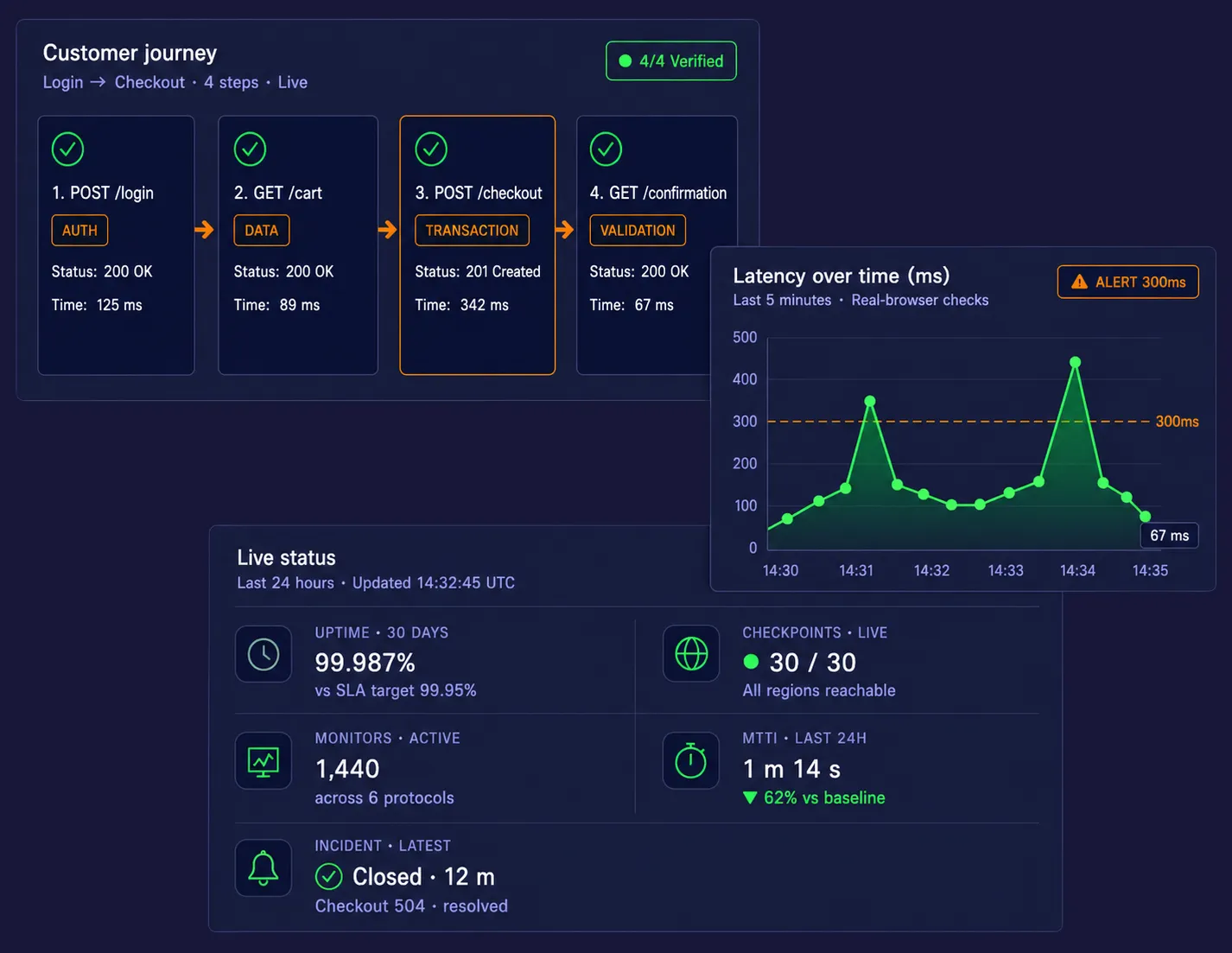
It’s not just checking if a homepage loads. Advanced synthetic application monitoring scripts complete full user journeys:
- Log in → Search for product → Add to cart → Apply promo code → Checkout → Receive confirmation.
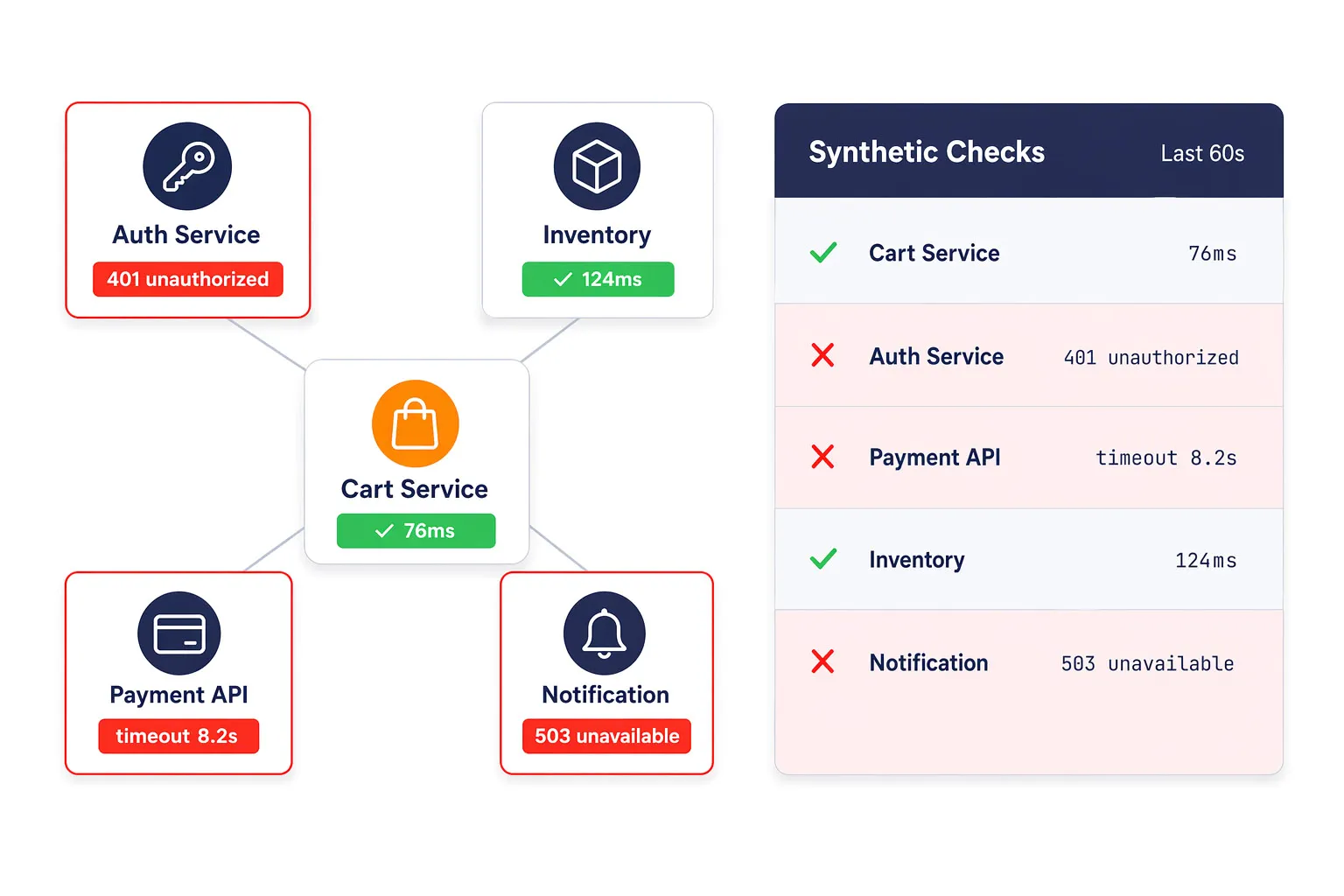
- API call → Validate JSON response → Check response time threshold → Verify data integrity.
- Mobile app open → Load content → Interact with features → Background sync.
Geographic Intelligence
The most proactive teams run synthetic tests in staging and development environments. This way, they will identify performance issues before the code goes into production.
Pre-Production Safety Net
The most proactive teams run synthetic tests in staging and development environments, catching performance regressions before code ever reaches production.
The “Before & After” Narrative: Two Worlds, Two Responses
Let’s examine a real-life example of how synthetic application monitoring transforms how to respond problems:
Scenario A: The Reactive World (Before Synthetic Monitoring)
Timeline of an Avoidable Disaster:
- 9:00 AM: Deployment completes successfully. All automated tests pass.
- 2:15 PM: The First user complaint appears on Twitter: “Can’t complete purchase on @YourSite.”
- 2:30 PM: Internal metrics show a 15% checkout failure rate. Revenue tracking plummets.
- 2:45 PM: The War room assembles. Engineers begin a frantic log search.
- 3:30 PM: Hypothesis: Payment gateway issue. But which one? Stripe, PayPal, or Adyen?
- 4:00 PM: Root cause identified: Adyen’s European endpoints are experiencing 8-second timeouts.
- 4:30 PM: Workaround implemented: Failover to backup processor.
- 5:00 PM: Service restored.
Result: 2.5+ hours of partial outage, 7% daily revenue lost, 500+ frustrated customers, 5 engineers pulled from strategic work, and one very stressful afternoon.
Scenario B: The Proactive World (With Synthetic Application Monitoring)
Timeline of a Prevented Incident:
- 9:00 AM: Deployment completes successfully.
- 9:02 AM: The Synthetic monitor in Frankfurt detects a 3-second slowdown in the Adyen API call (still within the overall transaction timeout but trending poorly).
- 9:03 AM: Alert hits DevOps Slack: “Performance degradation detected: Checkout flow +3s from Frankfurt. Success rate: 100%, but trending.”
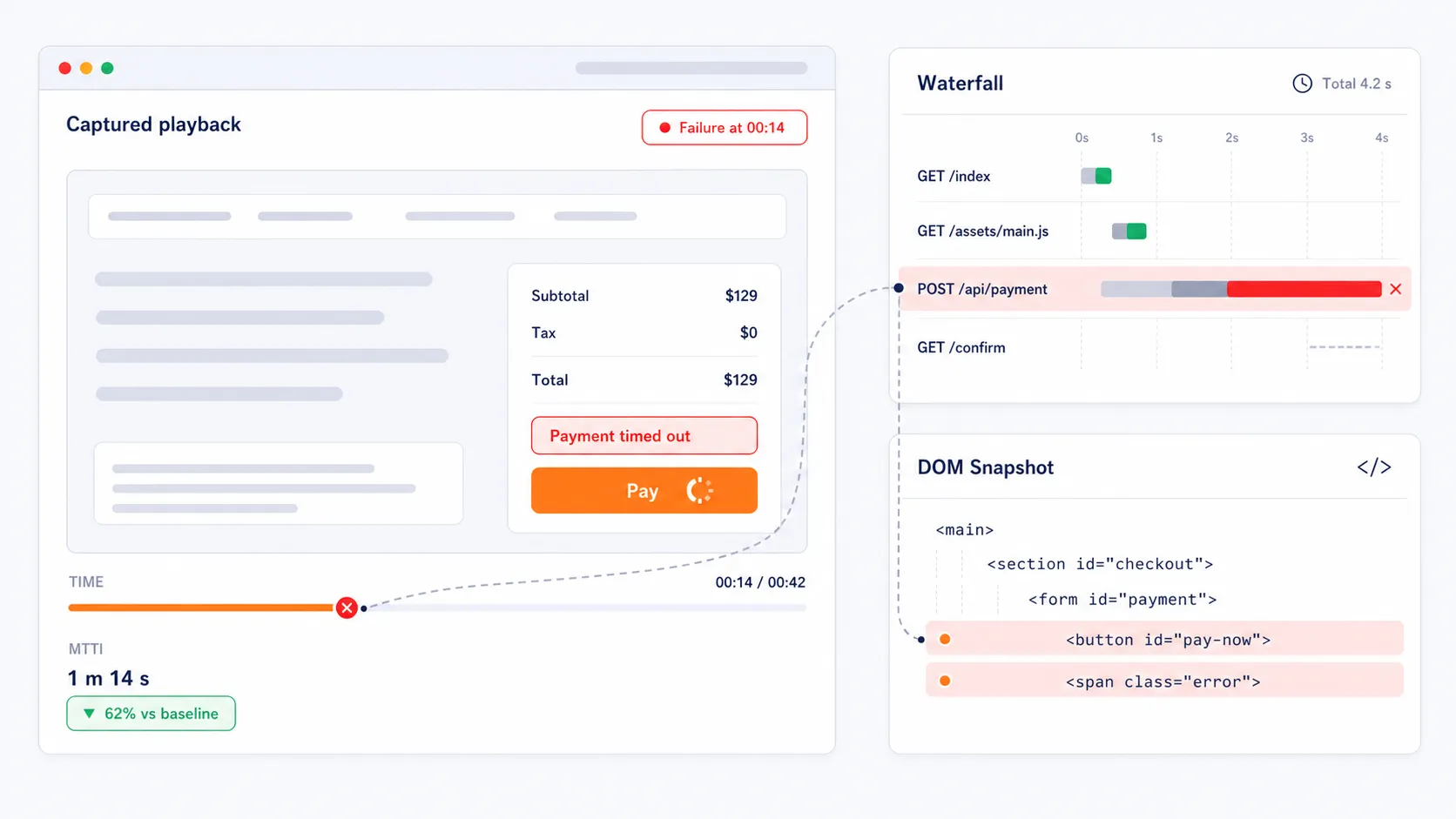
- 9:05 AM: Engineer investigates pre-enriched alert: The Full transaction waterfall shows the Adyen latency spike isolated to Europe.
- 9:10 AM: The Team checks the Adyen status page (no reported issues) but implements graceful degradation: European users are routed to the backup processor.
- 9:15 AM: Synthetic monitors show European checkout back to normal (<2s) via backup processor.
- 9:30 AM: Adyen resolves their issue. The team monitors synthetic checks before re-enabling the primary processor.
Result: Zero user impact, zero revenue loss, issue addressed during business hours, team maintains focus on strategic projects, and customers experience uninterrupted service.
Key Features That Enable True Proactive Prevention
Modern synthetic application monitoring tools like Dotcom-Monitor include features that turn proactive approaches from ideas into real things such as:
Intelligent Alerting with Context
- Multi-location failure confirmation: Only alerts when two or more locations fail, which eliminates the risk of false positives at a single point.
- Performance degradation alerts: Get notification about slowdowns before they turn into failures.
- Enriched diagnostics: Every alert includes screenshots, waterfall charts, console logs, and correlation data.
- Integrated escalation: Go directly to Slack, PagerDuty, Microsoft Teams, or ServiceNow.
Advanced Transaction Scripting
- No-code recorder: Get real user interactions without having to write code.
- Dynamic element handling: Automatic waiting for SPAs, AJAX calls, and lazy-loaded content.
- Assertion validation: Look for specific syntax objects, response codes, or effectiveness indications.
- Logic that is conditional: Make complicated “if-then” monitoring situations.
- Conditional logic: Create complex “if-then” monitoring scenarios.
AI-Powered Anomaly Detection
- Behavioral baselining: Learn normal patterns for each transaction, location, and time.
- Seasonal awareness: Recognize weekly, monthly, or holiday patterns without manual tuning
Correlation engine: Connect synthetic failures with infrastructure metrics, deployment events, or third-party status changes.
Ready to explore a comprehensive synthetic monitoring solution? Discover how Dotcom-Monitor’s platform provides 24/7 proactive protection for your applications:
Explore Synthetic Monitoring Features
Full Fidelity Performance Measurement
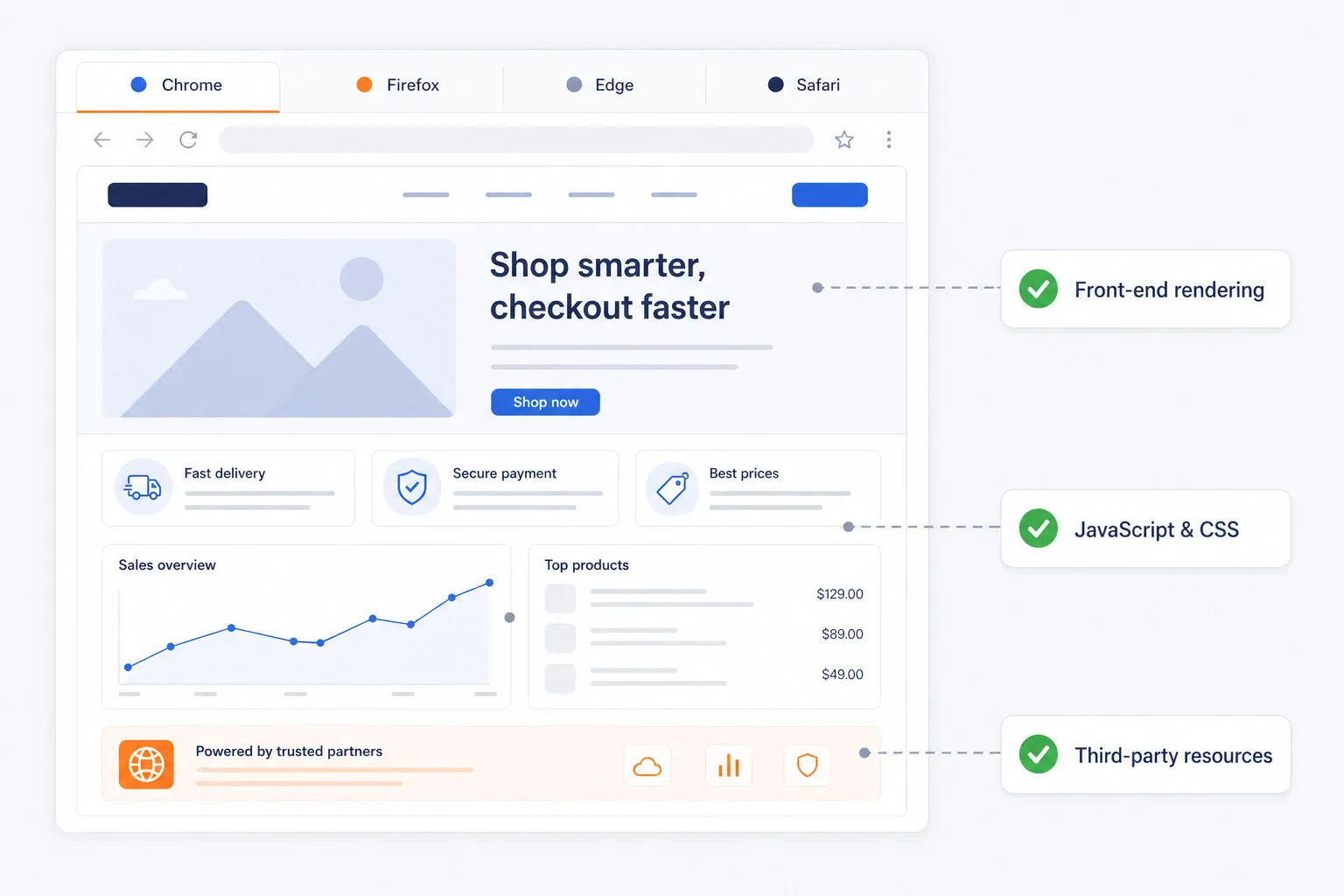
- Core Web Vitals tracking: Monitor LCP, FID, and CLS from real browsers worldwide.
- Resource-level analysis: Identify slow third-party scripts, oversized images, or blocking resources
- Network-level insights: Measure DNS resolution, SSL handshake, and TCP connect times.
Integration Strategy: Making Proactive Part of Your DNA
Synthetic application monitoring delivers maximum value when integrated into existing workflows:
CI/CD Pipeline Gates
- Pre-merge validation: Lightweight synthetic smoke tests on feature branches
- Post-deployment verification: Full transaction suite runs after staging deployment
- Performance regression prevention: Block releases that degrade key user journeys by >20%.
- Canary validation: Verify new releases with synthetic checks before increasing traffic.
Complementary Observability
Think of your monitoring stack as a pyramid:
- Base layer (Proactive): Synthetic application monitoring—tells you what’s broken or slowing.
- Middle layer (Diagnostic): APM and logging—tells you why it’s broken.
- Top layer (Validation): Real User Monitoring—confirms real users are experiencing what you expect.
Incident Response Enhancement
- Automated runbooks: Trigger specific diagnostic flows based on synthetic failure patterns
- Historical comparison: “This transaction normally takes 1.2s but is now taking 4.8s”.
- Geographic isolation: “Issue affects Asia-Pacific region only” immediately narrows investigation.
Step Framework for Implementation
Transitioning from reactive to proactive doesn’t require overhauling everything at once:
Step 1: Identify Critical User Journeys (Week 1)
- Map 3-5 business-critical transactions (checkout, login, search, etc.)
- Prioritize by revenue impact and user frequency
- Document success criteria and performance SLAs for each
Step 2: Script and Deploy Initial Monitors (Week 2)
- Start with simple, single-page checks
- Progress to multi-step transactions
- Deploy in 3-5 key geographic regions matching user concentration
Step 3: Set Intelligent Thresholds (Week 3)
- Performance SLAs: “Checkout must complete in <3s from all regions”.
- Availability requirements: “99.95% success rate over 15-minute rolling window”
- Graduated alerting: Warning at 80% of threshold, critical at 120%
Step 4: Integrate with Incident Response (Week 4)
- Connect alerts to your on-call system
- Create runbook templates for common failure patterns
- Establish escalation paths based on synthetic data
Step 5: Review, Optimize, and Expand (Ongoing)
- Weekly review of prevented incidents
- Monthly tuning of thresholds based on seasonal patterns
- Quarterly expansion to new user journeys and regions
The ROI of Proactive: More Than Just Uptime
The business case for synthetic application monitoring extends far beyond avoiding outages:
Quantifiable Benefits
- Downtime reduction: Teams typically reduce unscheduled downtime by 70-85%.
- MTTR improvement: Mean Time to Resolution drops by 40-60% with enriched diagnostic data.
- Team efficiency: 30-50% reduction in firefighting time, freeing engineers for innovation
- Revenue protection: Direct savings from preventing peak-period outages
Qualitative Advantages
- Customer trust: Consistent reliability builds brand loyalty and reduces churn.
- Competitive differentiation: In crowded markets, reliability becomes a feature.
- Team morale: Engineers prefer building over fixing, reducing burnout and turnover.
- Business agility: Confidence to deploy more frequently with safety nets in place
Common Objections—And How to Overcome Them
We already have monitoring tools.
Most tools are retrospective. Synthetic monitoring is prospective. It’s the difference between a security camera (records what happened) and a motion sensor (alerts before something happens).
False alerts will overwhelm us.
Modern platforms reduce false positives by 90%+ through AI correlation, multi-location logic, and behavioral baselining. You tune once, then benefit continuously.
Our team doesn’t have time to implement this.
The average setup takes 2-3 hours for initial critical transactions. Compare that to the 20+ hours typically spent monthly fighting preventable fires.
It’s too expensive.
Calculate your downtime costs. If you’re losing $10,000/minute during outages, preventing just one 30-minute outage pays for years of synthetic monitoring.
The Future Is Proactive, and It Starts Right Now
The world of technology has transformed but many businesses still use the same monitoring approaches. People today want solutions to be available all the time, respond in less than a second, and work perfectly on all devices and in every region of the world. To meet these goals, we need to change from reactive monitoring to proactive detection.
Monitoring synthetic applications is more than just another tool; it’s an approach to examining reliability engineering. You get the best advantage by capturing real user experiences before real potential clients arrive. This provides you time to respond, time to resolve issues, and time to make sure that nothing gets in the way of the customer journeys that keep your business growing.
The best outages aren’t the ones you fix immediately; they’re the ones that never occur for your users. The question isn’t if you can afford to use synthetic monitoring; it’s if you can afford not to.
Ready to experience proactive monitoring?
Start your free 30-day trial of Dotcom-Monitor’s synthetic application monitoring platform today—no credit card required. See firsthand how you can prevent downtime before it affects your users: