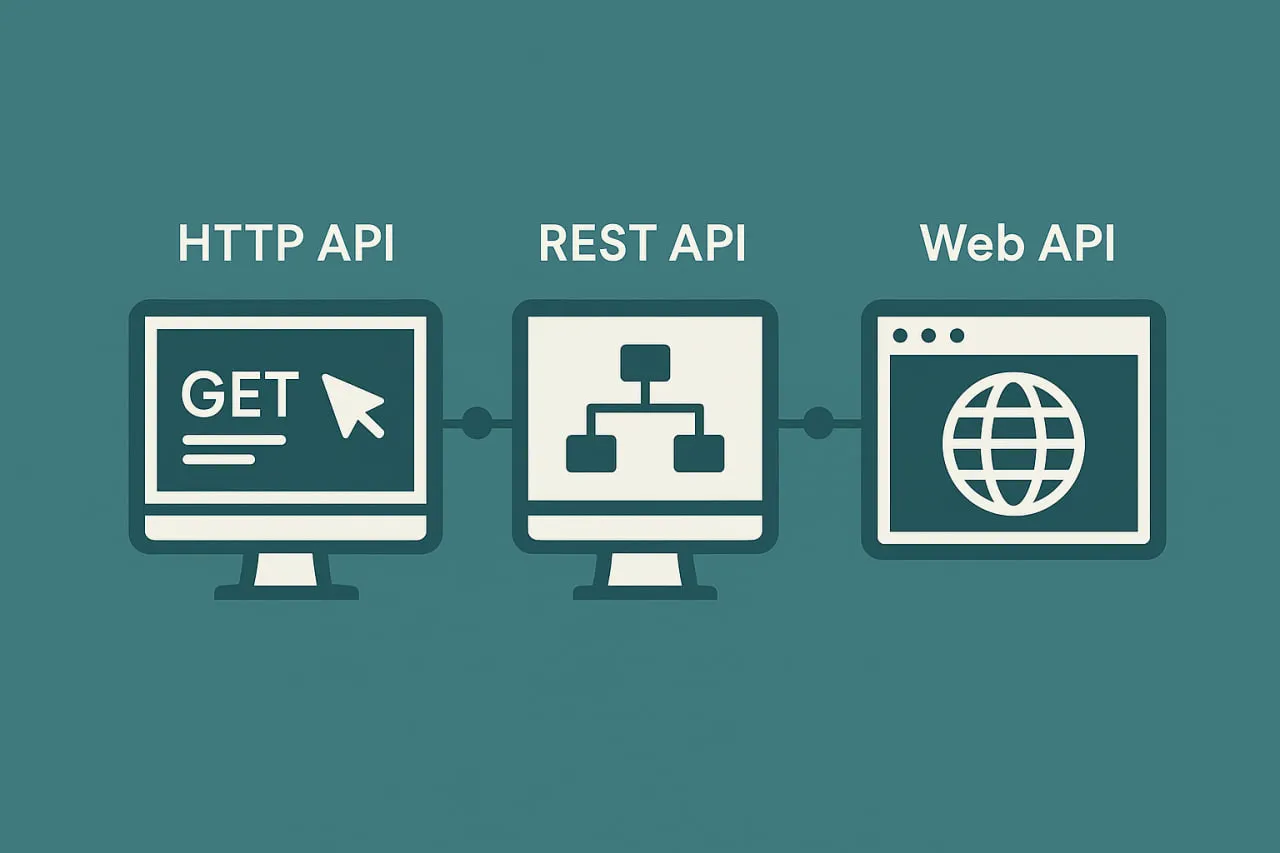
 APIs power everything. From login flows to checkout systems to internal microservice communication. But as teams scale, so does the confusion around the terminology: HTTP API vs REST API vs Web API. Many articles treat these as interchangeable, but the differences are real, and they affect reliability, performance, caching behavior, authentication flows, and ultimately how you monitor your endpoints.
In this guide, we’ll break down each architecture clearly, from HTTP’s simple request–response pattern to REST’s stateless, resource-oriented constraints to the broader world of Web APIs (SOAP, GraphQL, gRPC). And more importantly, we’ll show how these differences shape your monitoring strategy and determine how effectively you can track API health, manage SLA/SLOs, and design reliable multi-step synthetic workflows.
HTTP API vs REST API vs Web API: The Core Differences (and Misconceptions)
The terms HTTP API, REST API, and Web API often appear together, as if they describe the same thing. In reality, they represent different layers of abstraction in API architecture. Understanding these differences matters not just for design, but also for how you test availability, validate payloads, measure latency, monitor multi-step flows across distributed systems, and effectively monitor REST endpoints in production environments.
What Is HTTP (and What Is an HTTP API)?
HTTP is simply an application-layer protocol for sending requests and receiving responses. It’s transport-agnostic to API style. When engineers say HTTP API, they usually mean an API that directly exposes HTTP methods (GET, POST, PUT, DELETE) without necessarily adhering to any higher-level architectural constraints.
An HTTP API typically focuses on straightforward request/response actions:
GET /health→ returns a statusPOST /login→ returns a tokenPUT /cart/123→ updates a record
These APIs usually exchange JSON payloads, but they can return XML, text, or binary data. Their simplicity makes them fast to design, easy to extend, and flexible for internal microservices. However, because there’s no guaranteed uniform interface, monitoring them requires more explicit assertion of fields, status codes, and error messages. One endpoint may return { status: "OK" }, another might return { isAlive: true }—the lack of consistency shapes how DevOps teams build validation rules.
What Is REST (and What Makes an API Truly RESTful)?
REST is not a protocol; it’s an architectural style that builds on top of HTTP. To be “RESTful,” an API must follow a specific set of REST constraints:
- Client–Server separation
- Statelessness (no session state between requests)
- Cacheable responses
- Uniform interface (predictable resource naming and interactions)
- Layered system
- Optional: HATEOAS / hypermedia links
REST APIs traditionally model resources rather than actions:
GET /users/42PATCH /orders/531/status
This uniform interface makes REST APIs easier to monitor at the resource level. For example, if /users/{id} always returns a consistent envelope with predictable fields, a monitoring workflow can validate JSON schema, response time, and authentication behavior using a single reusable template.
It also means REST APIs benefit from test patterns that verify statelessness, idempotency for PUT/PATCH, and cache-control headers—areas where HTTP APIs don’t promise consistency.
What Is a Web API?
Web API is an umbrella term for any API exposed over the web, RESTful or not. This includes:
- SOAP (XML envelopes with a strict schema)
- GraphQL (single endpoint with schema-driven queries)
- gRPC (binary RPC over HTTP/2)
- Classic REST
- Basic HTTP APIs
Where competitors often reduce Web API to “.NET Web API,” the term is much broader. A Web API might rely on XML schemas, WSDL contracts, or RPC signatures rather than REST conventions. As a result, monitoring them varies widely: SOAP requires XML validation, GraphQL requires resolver-level assertions, while gRPC requires protocol-aware instrumentation.
This complexity is exactly why our guide on Web API monitoring emphasizes choosing the right validation model based on the architecture, not merely the transport protocol.
Clearing Up the Common Misconceptions
Misconception #1: “REST = JSON over HTTP.”
False. JSON is common, but RESTful design is defined by architectural constraints, not media types.
Misconception #2: “HTTP API and REST API are the same.”
They overlap, but REST adds requirements like uniform interface, resource modeling, and statelessness.
Misconception #3: “Web API means REST API.”
Web APIs can use SOAP, GraphQL, RPC, or custom formats. REST is just one subset of the broader category.
Summary Comparison Table
| Architecture | What It Really Means | Strengths | Monitoring Impact |
|---|---|---|---|
| HTTP API | Requests over HTTP without strict design rules | Fast, flexible | Must validate outputs per-endpoint; inconsistent patterns |
| REST API | Resource-based design following REST constraints | Predictable, cacheable, scalable | Schema validation, resource consistency, stateless monitoring |
| Web API | Any API exposed via web protocols | Very broad; includes SOAP/GraphQL/gRPC | Monitoring varies widely—XML, queries, RPC, or HTTP |
Choosing the Right Architecture: Use Cases, Trade-Offs & Performance
Choosing between an HTTP API, a REST API, or a broader Web API architecture is not just about preference; it shapes latency behavior, caching opportunities, authentication flows, payload structure, and ultimately the way your system scales under real-world traffic. Modern engineering teams consider not only the design philosophy but also the operational and monitoring implications.
When HTTP APIs Are Enough
HTTP APIs shine when teams want maximum flexibility with minimal ceremony. They’re ideal for internal microservices, backend-to-backend communication, lightweight mobile endpoints, Webhook receivers, or any workflow where the payload format and semantics may evolve quickly.
Because HTTP APIs aren’t constrained by uniform resource rules, teams can expose action-style endpoints like /process-payment or /sync-data, which don’t cleanly fit “resource” semantics.
However, this flexibility comes with trade-offs. Without predictable schemas or conventions, monitoring must treat each endpoint as a unique case: one may return a 200 with a success=true field; another returns 201 with a different JSON envelope. This inconsistency increases the need for explicit assertion rules like field validation, status code mapping, and edge-case handling, especially across distributed deployments.
When REST APIs Excel
REST shines when resource modeling, scalability, and long-term maintainability matter. Its constraints (stateless interactions, cacheable responses, and uniform interface) aren’t academic; they directly improve reliability and observability.
A RESTful /products/{id} endpoint is predictable, cache-friendly, and easy to monitor across CRUD operations. Statelessness simplifies synthetic monitoring because each request must succeed independently without relying on hidden session state. Caching rules help reduce latency, and consistent path structures make it easier to standardize schema validation or JSONPath assertions.
REST is also powerful for public-facing APIs with broad consumers, where predictable versioning and backward compatibility are essential. Many engineering teams adopt REST not because it’s trendy, but because its constraints reduce operational entropy.
Where Web APIs Fit (SOAP, GraphQL, gRPC, and Beyond)
Web APIs include architectures far beyond REST. SOAP excels in enterprise environments requiring strict schema validation and XML envelopes.
GraphQL supports flexible, client-defined queries, compressing multiple round trips into a single request but requiring careful monitoring of resolver performance and over-fetching. gRPC offers high-performance, binary RPC over HTTP/2, ideal for internal microservices where throughput and efficiency matter.
These choices reflect architectural priorities:
- SOAP for strongly typed contract validation
- GraphQL for client-driven data needs
- gRPC for low-latency service-to-service communication
- REST for predictable web interoperability
- HTTP APIs for flexibility above all else
Each architecture’s strengths also change how you measure performance, latency, and availability. This is why our Web API monitoring setup guide is structured around workflows rather than labeling APIs by type, your monitoring strategy has to match the underlying architecture, not the name.
Why Architecture Choice Directly Impacts API Monitoring Strategy
Most articles stop at defining HTTP, REST, and Web APIs, but what engineers actually struggle with is operationalizing them. API architecture determines how you measure reliability, validate payloads, detect latency regressions, and troubleshoot failures across multi-step workflows. Different architectures fail in different ways, and your monitoring needs to adapt to those patterns rather than applying a single “check that it returns 200 OK” approach.
How HTTP Design Affects Monitoring
Because HTTP APIs don’t enforce uniform structures, their monitoring requires custom assertions per endpoint. A health check like GET /status may return a simple text string in one service and a nested JSON object in another. Without predictable response envelopes or conventions, DevOps teams must explicitly define what “healthy” means: field presence, numeric ranges, keyword matching, authentication behavior, or time-to-first-byte expectations.
HTTP APIs often evolve organically across teams, so monitoring needs to capture variations. A payment service might return { "success": true }, while a user service returns { "status": "ok" }. This inconsistency increases reliance on JSONPath assertions, schema drift detection, and per-endpoint latency baselines. When internal HTTP APIs communicate with each other across microservices, even minor changes can cascade into multi-component outages—making dependency-aware monitoring essential.
Why REST Constraints Shape Monitoring Behavior
REST’s emphasis on statelessness, cacheable responses, and consistent resource modeling makes monitoring more systematic. Because REST endpoints follow predictable resource paths (/orders/{id}, /users/{id}/preferences), you can design reusable monitoring workflows that validate each part of a CRUD lifecycle.
Statelessness reduces ambiguity: every synthetic request must succeed without relying on session state. That means failures are easier to isolate, and monitoring tools can accurately detect whether pagination, idempotency, or concurrency rules behave as expected.
REST also benefits from schema validation. If every GET /product/{id} returns the same JSON structure, you can track average payload size, detect missing fields, or flag backwards-incompatible changes. Monitoring cache headers can also confirm whether clients receive efficient responses, exposing performance regressions caused by misconfigured caching layers.
Web APIs Introduce Their Own Monitoring Complexities
Because Web APIs include SOAP, GraphQL, gRPC, and custom protocols, monitoring strategies vary dramatically. SOAP requires XML envelope validation and strict schema checks. GraphQL demands monitoring of resolver execution time, data shape consistency, and query cost. gRPC needs binary-aware instrumentation and performance baselines across streaming RPCs.
This broader category adds authentication variants, including OAuth 2.0, API keys, HMAC signatures, and mutual TLS, and each authentication model changes what synthetic monitoring must simulate. OAuth, for example, requires a token retrieval step followed by one or more chained resource calls, making multi-step workflows essential.
This is why modern teams rely on synthetic monitoring to test end-to-end flows across chained requests. Rather than checking a single endpoint, multi-step monitors replicate real user traffic: retrieve token → call resource → assert fields → validate latency budgeting. When distributed across global probe locations, these tests reveal regional performance issues, DNS problems, or intermittent 503s that slip past unit-level checks.
We discuss these multi-step techniques more deeply in the next section, but the core idea is simple: monitoring must match the architectural behavior, not the protocol name.
Monitoring Patterns for Modern APIs (HTTP, REST & Web APIs)
Monitoring modern APIs isn’t about checking whether an endpoint returns a 200—it’s about validating behavior across workflows, authentication steps, data contracts, latency budgets, and SLO targets. Because HTTP APIs, REST APIs, and Web APIs behave differently, engineering teams rely on several monitoring patterns, each suited to a different architectural model.
Pattern 1: Basic HTTP Health Checks (Simple Availability Tests)
The simplest form of monitoring checks whether an API endpoint responds at all. These basic HTTP tests work well for lightweight services, stateless microservices, and simple integrations like /health or /ping.
A typical health check validates:
- Status code
- Body contains a known keyword or JSON field
- Response time falls within expected latency
Simple HTTP monitors are useful, but they only catch surface-level failures. For most production environments, deeper validation is required.
Pattern 2: JSON Schema and Field-Level Validation
Once responses move beyond plain text, basic checks fall short. Schema validation ensures that API responses remain stable over time—crucial when multiple services depend on consistent data contracts.
REST APIs benefit most from schema validation because of their predictable resource structures. Monitoring might check that:
- Required fields exist (
id,name,status, etc.) - Data types match expected patterns
- Optional fields don’t disappear silently
- Payload size stays within expected bounds
Schema drift is a leading cause of downstream service failures. Catching it early prevents breaking changes from reaching production.
Pattern 3: RESTful CRUD Workflow Monitoring (Multi-Step Sequence)
A single REST operation rarely exists in isolation. A real workflow might require:
POST /cartto create a resourceGET /cart/{id}to confirm fieldsPATCH /cart/{id}to update stateDELETE /cart/{id}to clean up
A multi-step synthetic workflow ensures that the full lifecycle behaves as expected—not just individual endpoints.
When explaining how to configure such workflows, we reference your REST Web API task configuration guide, which shows how to set up chained assertions and validation rules.
Pattern 4: OAuth Token Retrieval + Chained Requests
OAuth 2.0–based APIs require a token exchange before accessing protected resources. Monitoring OAuth correctly means simulating the full authentication flow:
- Request access token
- Extract token from JSON
- Call the protected endpoint with a bearer token
- Validate response fields, headers, and latency
- Assert expiration or refresh behavior
Your OAuth documentation emphasizes the need for multi-task devices that simulate authentication → query → follow-up action. Because OAuth involves timing, token lifetimes, and transient failures, this pattern is essential for monitoring high-security APIs.
Pattern 5: Monitoring GraphQL (Query, Variables & Schema Validation)
GraphQL changes the validation model entirely: a single endpoint can generate infinite response shapes. Monitoring must verify:
- Query execution time
- Resolver errors
- Expected fields in nested structures
- Query cost or depth (to catch runaway queries)
Schema-aware checks help detect backwards-incompatible changes before they break clients.
Pattern 6: Monitoring SOAP APIs (XML + Envelope Validation)
SOAP sits on the opposite end of the spectrum from GraphQL. Its strength lies in strict contract enforcement. Monitoring SOAP requires:
- XML schema validation
- Envelope structure checks
- Fault message handling
- Authentication and header validation
Because SOAP errors often hide inside structured fault bodies, monitoring needs to parse XML deeply rather than checking for a simple “OK.”
Pattern 7: Importing Postman Collections Into Monitoring
Many teams maintain extensive Postman test suites. Rather than recreating them manually, they can import Postman collections directly into an API monitoring workflow to reuse assertions, variables, and test logic.
This section references your Postman collection monitoring guide, which explains how to convert local test suites into cloud-based synthetic tests.
SLA/SLO Reporting, Alert Thresholds & Error Budgets
Beyond functional monitoring, teams track performance against SLOs like:
- p95/p99 latency
- Error budgets (allowed downtime per month)
- Per-region availability
- Throughput patterns at peak vs off-peak hours
These metrics reveal early signs of degradation—timeouts, network jitter, intermittent 503s—that single-step checks miss.
How Dotcom-Monitor Helps Monitor HTTP, REST & Web APIs
Monitoring APIs isn’t just about running a request every few minutes; it’s about validating entire workflows, authentication exchanges, data contracts, and performance guarantees across global environments. Dotcom-Monitor’s Web API monitoring engine is built specifically for this complexity, offering synthetic checks that can simulate the exact flows your services rely on.
Multi-Step Synthetic Monitoring for Full Workflows
Unlike basic uptime checkers, Dotcom-Monitor allows you to chain requests together in the exact sequence your backend expects:
authenticate → query endpoint → follow-up request → validate fields → measure latency → assert status codes.
This works equally well for HTTP APIs with custom logic, REST APIs with CRUD lifecycles, and Web APIs like SOAP, GraphQL, or gRPC-style payloads (via HTTP interactions).
The Web API Monitoring product page goes deeper into how synthetic flows behave across distributed system dependencies.
Global Monitoring Nodes for Realistic Latency Testing
APIs behave differently across regions. Dotcom-Monitor tests endpoints from global probe locations, revealing issues like high DNS lookup times, TLS handshake delays, or region-specific 503s that localized testing won’t catch. Teams can baseline p95 latency for each region and monitor degradation over time.
Advanced Assertions, OAuth Support & Payload-Level Checks
Dotcom-Monitor supports:
- JSON/XML field validation
- JSONPath & XPath assertions
- Header validation
- OAuth 2.0 token retrieval
- Custom multi-step authentication logic
- XML envelope checks for SOAP
This lets you validate not only that an endpoint is “up,” but that it behaves according to your contract—including authentication flows, schema structure, and field-level accuracy.
SLA/SLO & Reporting Built for Engineering Teams
With SLA dashboards, error-budget views, availability reports, and per-endpoint latency breakdowns, engineering teams gain observability into the health of their API fleet.
The Web API monitoring setup guide explains how to configure these workflows, including assertions, thresholds, and multi-step chaining.
Frequently Asked Questions
/run-report, whereas REST emphasizes resources, statelessness, and a uniform interface.Yes. Many teams import Postman test suites directly into monitoring platforms to reuse variables, assertions, and workflows. This avoids duplication and ensures parity between local tests and cloud monitors.
For .NET teams, our .NET Web API monitoring guide explains additional considerations.