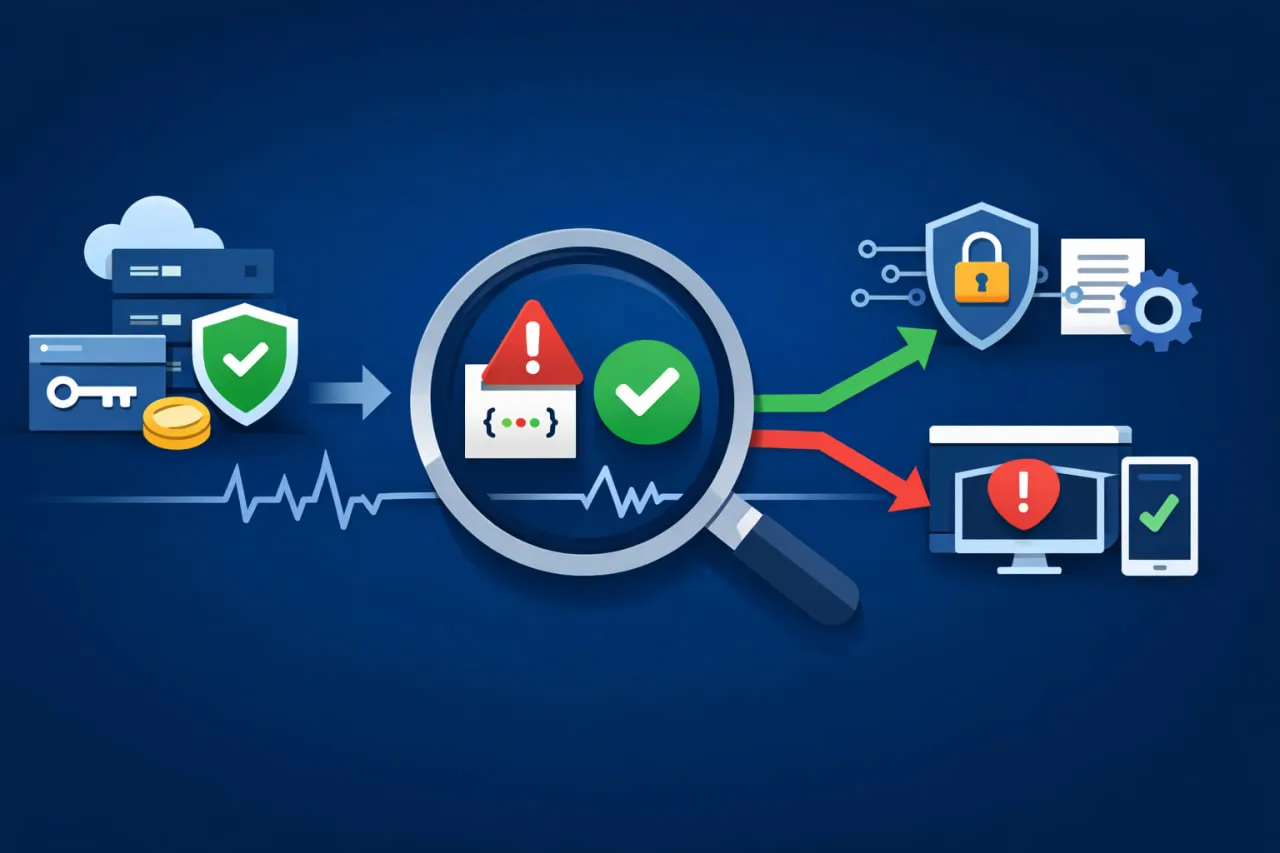
 Modern APIs rarely fail because the application logic is down. More often, they fail because authentication breaks upstream, silently.
OAuth token endpoints and JWT-based authentication sit at the front of nearly every protected API. When they degrade, misconfigure, or stop issuing valid tokens, every dependent API call fails, even if the API itself is healthy. Yet most teams still treat authentication as a configuration concern rather than a production dependency that must be monitored.
This article explains how to monitor JWT tokens and OAuth token endpoints in real-world production environments, what competitors and specs fail to cover, and how to detect authentication failures before they cascade into API outages.
Why OAuth Token Endpoints and JWTs Are a Single Point of Failure
OAuth token endpoints and JWT-based authentication are often treated as background infrastructure, configured once and assumed to “just work.” In reality, they are one of the most critical single points of failure in modern API architectures.
Every authenticated API request depends on two things happening correctly:
- the OAuth token endpoint must issue a token, and
- the JWT must be accepted by downstream APIs.
If either fails, the API is effectively unavailable, even if the application itself is healthy.
What makes this especially dangerous is that authentication failures rarely look like traditional downtime. Token endpoints can return HTTP 200 responses that still contain errors. JWTs can be issued successfully but rejected later due to expired claims, invalid audiences, or signing key rotation. From the outside, everything appears “up,” while users experience broken logins, failed API calls, or cascading authorization errors.
This is why OAuth token endpoints should be viewed as production dependencies, not implementation details. They sit upstream of every protected API and have an outsized blast radius when something goes wrong. Yet most monitoring strategies focus on API availability alone, ignoring the authentication layer entirely.
To monitor APIs effectively, teams need visibility into how authentication behaves in production, not just during testing or deployment. That requires treating OAuth token issuance and JWT validation as first-class monitoring targets, not assumptions.
JWT Tokens vs OAuth Token Endpoints: What Needs Monitoring (and Why)
JWT tokens and OAuth token endpoints are tightly connected—but they fail in very different ways. Treating them as the same monitoring problem is one of the most common reasons authentication issues slip into production unnoticed.
JWTs are the output.
Once issued, they’re reused across API calls to authorize access. Problems usually appear after issuance.
Common JWT-related failures include:
- Expired exp claims
- Clock skew between systems
- Invalid audiences (aud)
- Missing or incorrect scopes
- Signature validation failures after key rotation
In these cases, the token still exists and is passed correctly, but downstream APIs reject it. From the outside, this often looks like an API authorization error—not an authentication problem.
OAuth token endpoints are the source.
They are responsible for issuing tokens in the first place, and failures happen before any API call is made.
Typical token endpoint issues include:
- Endpoint downtime or high latency
- Invalid or rotated client credentials
- Misconfigured grant types
- Throttling or rate limiting
- Internal identity provider failures
What makes token endpoint failures especially dangerous is that many return HTTP 200 responses with error payloads. Basic uptime checks pass, even though authentication is broken.
This is why OAuth web API monitoring must cover both layers:
- Token issuance health (Is the token endpoint behaving correctly?)
- Token usability (Does the issued JWT actually authorize API requests?)
Monitoring only one side creates blind spots. Monitoring both—together and in sequence—is how teams detect authentication failures early and accurately.
Why OAuth and JWT Failures Are Hard to Detect in Production
OAuth and JWT failures are rarely obvious. In fact, they’re some of the hardest production issues to detect, even in mature monitoring setups.
The biggest reason is that most authentication failures don’t look like outages.
OAuth token endpoints often remain reachable and responsive, even when they’re broken in practice. A token request may return an HTTP 200 status while the response body contains an error such as invalid_client or invalid_grant. From the perspective of basic uptime monitoring, everything appears healthy—even though no valid tokens are being issued.
JWT-related failures are even more subtle. Tokens can be issued successfully and still fail later due to:
- Expired or skewed expiration claims
- Invalid audiences after API changes
- Missing scopes required by downstream services
- Signature validation failures after key rotation
In these cases, authentication fails downstream, inside the API layer. The token endpoint looks fine. The API endpoint looks fine. But users experience authorization errors that are difficult to trace back to the root cause.
CI tests don’t help much here either. They validate OAuth flows at deploy time, not continuously. Client secrets rotate, identity providers throttle, and configuration changes happen long after a build passes.
This is why production authentication issues often surface only after users complain or error rates spike.
To reliably detect these problems, teams need synthetic monitoring that behaves like a real client in production; requesting tokens, validating responses, and using those tokens in live API calls on a continuous basis. Without that visibility, OAuth and JWT failures remain invisible until they cause real damage.
What Monitoring OAuth Token Endpoints Actually Means
Monitoring an OAuth token endpoint is often misunderstood as simply checking whether the endpoint responds. In practice, that approach misses most real authentication failures.
True OAuth token endpoint monitoring validates behavior, not just availability.
At a basic level, the token endpoint must be reachable and respond within acceptable latency. But availability alone doesn’t guarantee that authentication is working. Token endpoints frequently return HTTP 200 responses even when authentication fails, embedding errors inside the response body. If monitoring stops at status codes, these failures go undetected.
Effective monitoring also validates response correctness. A healthy token endpoint should return:
- A token in the expected format
- Required fields such as access_token, token_type, and expires_in
- Error-free responses for valid credentials and grant types
Beyond structure, monitoring must account for token validity. Tokens should have:
- Reasonable expiration windows
- Expected scopes
- Correct audiences for downstream APIs
However, even a well-formed token is not enough. One of the most common production issues is issuing a token that cannot actually be used. This happens when scopes change, APIs enforce stricter authorization rules, or identity provider configurations drift over time.
This is why teams rely on Web API monitoring tools like Dotcom-monitor to validate authentication flows end to end. Instead of checking the token endpoint in isolation, the monitor requests a token and immediately uses it in a real, protected API call. If authorization fails, the issue is detected instantly—before users are impacted.
From an operational standpoint, OAuth token endpoints should be monitored the same way teams monitor databases or message queues: as critical dependencies whose failure can break the entire system.
Monitoring JWT Tokens in Context (Not in Isolation)
Monitoring JWT tokens in isolation provides a false sense of security. A token can exist, look valid, and still fail when used in real API requests. This is why JWT monitoring only becomes meaningful when tokens are validated in context.
JWTs are designed to be self-contained, which makes them efficient—but also dangerous from an operations standpoint. Once issued, they’re reused across multiple API calls and services. If something changes downstream—such as required scopes, audience values, or authorization rules, previously valid tokens can start failing without warning.
Common context-related JWT failures include:
- Tokens accepted by one API but rejected by another
- Scope changes that break authorization logic
- Audience mismatches after API versioning or routing changes
- Token expiration issues caused by clock drift across systems
These failures don’t appear at the token endpoint. They surface only when the token is used, often deep inside an application workflow. As a result, teams may spend hours debugging “API issues” that are actually authentication problems.
This is where monitoring OAuth web APIs end to end becomes critical. Instead of validating a JWT on its own, monitoring should:
- Request a token from the OAuth token endpoint
- Extract the JWT dynamically
- Inject it into a protected API request
- Validate that authorization succeeds
This approach confirms not just that a token was issued, but that it is usable in production conditions.
By monitoring JWTs in context, teams gain early visibility into authorization failures, reduce false positives, and isolate authentication issues before they cascade across dependent services.
How to Monitor OAuth Token Endpoints with Multi-Step API Monitoring
Single-step checks aren’t enough for OAuth. To catch real authentication failures, monitoring must follow the same sequence your applications use in production. That’s where multi-step API monitoring becomes essential.
Step 1: Monitor the token endpoint directly
Start by validating the OAuth token endpoint itself. This includes more than uptime. Monitoring should check response time thresholds and parse the response body for authentication-specific errors like invalid_client, invalid_grant, or unauthorized_client. Many token endpoints return HTTP 200 even when authentication fails, so response validation is mandatory.
Step 2: Extract and reuse the issued token
When a token is issued, the monitor should dynamically extract the access token from the response. Hardcoding tokens or testing only static headers defeats the purpose. The goal is to behave like a real client that requests fresh tokens on a schedule.
Step 3: Use the token in a protected API call
Next, inject the token into a real, protected API request. This confirms token usability, not just issuance. If scopes are wrong, audiences don’t match, or authorization rules have changed, the failure will surface here, exactly where users would experience it.
Step 4: Alert on authentication-specific failures
Alerts should differentiate between:
- Token endpoint failures (credentials, grants, throttling)
- Authorization failures (scope, audience, expiration)
- Downstream API errors unrelated to authentication
This distinction reduces alert noise and speeds up root-cause analysis.
Teams often implement this workflow using Web API monitoring setup guides rather than custom scripts. With the right configuration, the entire OAuth flow can be monitored continuously without brittle code.
By validating token issuance and usage as a single workflow, multi-step monitoring turns OAuth from a blind spot into an observable dependency; one that fails loudly and early, instead of silently in production.
Common OAuth & JWT Monitoring Scenarios Teams Miss
Even teams with solid monitoring in place often miss predictable OAuth and JWT failure scenarios. These issues don’t show up as downtime, but they can instantly break authentication across APIs.
One of the most common problems is client secret rotation. Secrets expire or are rotated for security reasons, but monitoring configurations aren’t updated at the same time. Token requests start failing immediately, often returning invalid_client errors that basic uptime checks never catch.
Another frequent issue is redirect URI mismatches in authorization code flows. A minor change in callback URLs between environments can prevent tokens from being issued altogether. Because the authorization endpoint still responds, teams may not realize authentication is broken until users can’t log in.
Token expiration drift is another subtle failure mode. Differences in system clocks between identity providers and APIs can cause tokens to expire earlier than expected. APIs begin rejecting requests even though tokens appear valid when issued.
Environment-specific configuration issues also go unnoticed. OAuth may work in staging but fail in production due to different scopes, audiences, or identity provider settings. Without continuous monitoring, these discrepancies linger undetected.
This is why many teams rely on authorization code flow redirect URI mismatch monitoring and similar targeted checks to catch authentication failures early. By explicitly monitoring these edge cases, teams prevent small configuration changes from turning into widespread outages.
Turning OAuth Monitoring Data into Actionable Insights
Monitoring OAuth token endpoints and JWTs only delivers value if teams can act on the data. Raw pass/fail checks aren’t enough; what matters is understanding why authentication fails and how those failures evolve over time.
Authentication issues often follow patterns. Token endpoint latency may gradually increase before timeouts appear. Authorization failures may spike after a configuration change. Client credential errors may surface shortly after a secret rotation. Without historical context, these signals look like isolated incidents instead of early warnings.
This is where visibility and reporting become critical. By analyzing OAuth monitoring data through dashboards and reports, teams can:
- Track token endpoint availability and latency trends
- Identify recurring authentication error types
- Correlate auth failures with deployments or configuration changes
- Measure authentication reliability as part of API SLAs
Instead of reacting to user complaints, teams gain proactive insight into the health of their authentication layer. This shortens incident response times and makes root-cause analysis far more precise.
Clear reporting also improves cross-team communication. DevOps teams can show when failures originate in identity providers. API teams can distinguish authorization issues from application bugs. Security and IAM teams can validate that changes haven’t introduced unintended outages.
When OAuth and JWT monitoring data is structured, visible, and trendable, authentication stops being a black box. It becomes an observable system component, one that teams can measure, optimize, and trust.
When to Start Monitoring JWT Tokens & OAuth Endpoints
If your APIs rely on OAuth and JWTs, the right time to start monitoring authentication is before users are affected, well before support tickets or error spikes appear.
Monitoring becomes essential as soon as authentication is a runtime dependency, not just a setup step. This includes APIs that depend on third-party identity providers, machine-to-machine integrations using client credentials, or applications where access tokens expire and refresh continuously. In these environments, authentication health can change independently of application health.
Teams should also prioritize OAuth and JWT monitoring when:
- Client secrets or keys are rotated regularly
- Multiple environments (staging, production, regional deployments) exist
- Authorization rules or scopes change frequently
- APIs are part of customer-facing or revenue-critical workflows
Waiting for users to report login failures is already too late. By that point, authentication has failed silently for some time, and downstream systems may already be impacted.
Proactive monitoring turns authentication into a visible, measurable dependency. It allows teams to detect issues early, validate changes safely, and maintain confidence that APIs remain accessible, even as identity configurations evolve.
Start Monitoring OAuth Token Endpoints Before They Break Your APIs
OAuth token endpoints and JWT-based authentication are foundational to modern APIs, but they’re also fragile. When authentication fails, APIs don’t degrade gracefully. They stop working.
Most teams only discover OAuth issues after users report login failures, integrations break, or error rates spike across services. By then, authentication has already become the bottleneck.
Continuous monitoring closes that gap. By validating token issuance, token correctness, and token usability in real API calls, teams can detect authentication failures early, before they cascade into outages that affect customers and internal systems alike.
If OAuth is a dependency for your APIs, it should be monitored like one. Treating authentication as a first-class production concern helps teams move faster, deploy with confidence, and prevent silent failures from turning into high-impact incidents.
Start monitoring OAuth token endpoints now, and catch authentication issues before they break your APIs.