





Organizations Worldwide
Platform Uptime SLA
Global Monitoring Locations
Website Monitoring Leader
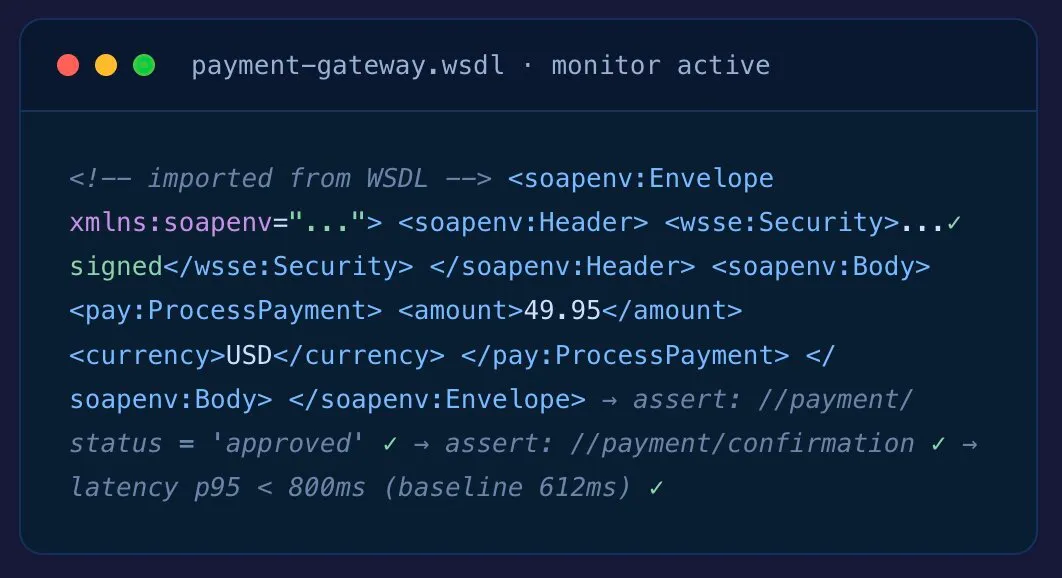
SOAP API monitoring is the continuous testing of SOAP-based web services from outside your infrastructure — validating SOAP envelope structure via XPath, WSDL contract conformance, WS-Security compliance, response time, and SOAP fault detection (a SOAP fault returns HTTP 200, so uptime monitors miss it). Alerts your team the moment any of those break.
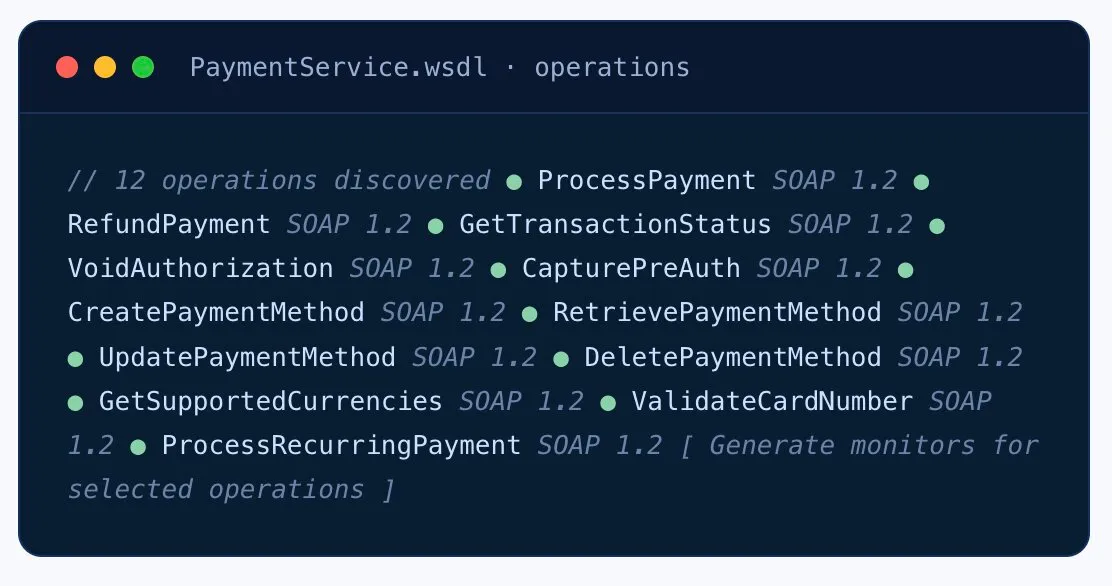
SOAP services come with a contract. Dotcom-Monitor reads your WSDL, parses every operation and binding, and turns it into monitors you can run from 30+ global locations within minutes — without hand-crafting envelopes.
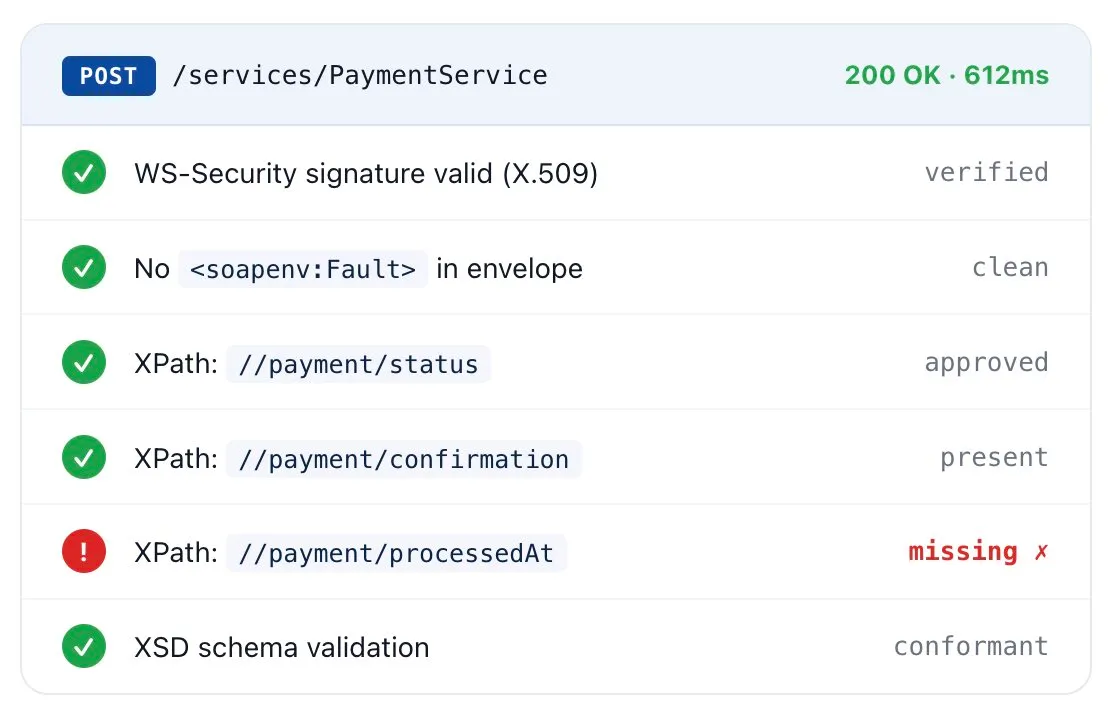
A SOAP fault wrapped inside HTTP 200 is still a failure. Dotcom-Monitor evaluates XPath expressions against the response envelope, validates SOAP faults, and runs the full WS-Security suite — so your monitor reflects the actual contract, not just the wire.
Most modern guides ignore SOAP. But it’s still the backbone of regulated industries — and the cost of a silent SOAP failure is usually higher than a REST one. Here’s what teams monitor with us.
Long-lived SOAP integrations to Visa, Mastercard, ACH networks, and bank-internal services. Monitor ProcessPayment, RefundPayment, GetTransactionStatus end-to-end.
Carrier APIs for quote, bind, claim submission, policy lookups. Mostly SOAP. Catch the silent contract drift that breaks a downstream policy management system.
EHR-to-EHR exchange, lab orders, prescription routing, insurance verification. Monitor that the envelope still parses and the patient data still validates against schema.
State filing systems, federal lookups, e-government identity services. SOAP, almost always with WS-Security and strict SLAs. Outages here trigger audit issues.
BizTalk, MuleSoft, WSO2, Tibco, IBM Integration Bus. The integration layer that ties ERP/CRM/HR systems together. Drop a Private Agent inside the network and monitor every queue.
SAP, Oracle, JD Edwards, Lawson — most ERP exposes SOAP for inventory, orders, shipping. Catch the integration that hangs and quietly stops syncing.
A performance engineer will walk you through WSDL import, XPath assertions, and WS-Security in your regulated environment — no sales pitch, just a working monitor by the end of the call.
Run distributed checks from 30+ owned monitoring locations to catch regional latency, DNS, and CDN issues against externally exposed SOAP services.
For the SOAP services that never leave your network — ESB endpoints, internal integration buses, on-prem service catalogs — deploy a Private Agent inside your VPC or datacenter. Outbound-only connection, no inbound firewall rules.
Global monitoring locations
Continents covered
Minimum check interval
For behind-firewall

4.5
80 reviews
4.6
4.6
All reviews sourced from Capterra verified reviews. Ratings as of January 2026.
Want to kick the tires without committing? Free Forever plan available — up to 25 targets, 2 monitoring locations, 7 days of data retention. Get started free → or Compare plans
Continuous testing of SOAP-based web services from outside your infrastructure. Validates that the service is reachable and responsive, that the XML envelope is well-formed, that XPath assertions pass, and that the response conforms to the WSDL contract — and alerts your team the moment any of those break.
Yes. Drop in a WSDL 1.1 or 2.0 file. Dotcom-Monitor parses operations, port types, bindings, and message schemas, then generates request templates so you can run monitors against any operation without hand-coding XML envelopes.
Yes — WS-Security with X.509 certificate signing, UsernameToken, SAML token, message-level encryption, and timestamp validation. Plus mTLS at the transport layer for client certificate auth.
Both. SOAP 1.1 (text/xml content type with SOAPAction header) and SOAP 1.2 (application/soap+xml) are fully supported, with correct content negotiation per binding.
Configure XPath expressions to evaluate against the response envelope, header, or any node. The monitor fails if an assertion returns an unexpected value, a missing node, or a wrong type. Common patterns: //transaction/status = 'approved' or count(//errors) = 0.
A SOAP fault returns HTTP 200 with a <soapenv:Fault> element inside the envelope — uptime monitors miss it entirely. We check explicitly for the Fault element and surface the faultcode and faultstring in the alert payload.
SOAP validates XML envelopes via XPath instead of JSON via JSONPath, parses WSDL contracts rather than OpenAPI specs, and handles enterprise auth schemes (WS-Security, SAML, mTLS) that are common in SOAP services. The underlying platform — global locations, multi-step chains, alerting, Private Agents — is shared. See REST API monitoring →
Yes. Deploy Private Agents inside your network — common for internal enterprise integration buses, on-prem service catalogs, and regulated environments. Outbound-only connection, no inbound firewall rules.
Long-lived integrations in banking, insurance, healthcare (HL7-via-SOAP, FHIR over SOAP), government, and ERP. SOAP’s strict WSDL contracts, the WS-* security stack, and transaction guarantees remain valuable in regulated environments. Replacing them with REST is rarely worth the risk — monitoring keeps them visible alongside modern services.
Yes. WS-Addressing headers (Action, To, MessageID, ReplyTo) can be set explicitly per request or imported automatically from a WSDL when the binding requires them.
Yes. MTOM/XOP attachment requests and responses are supported, including binary payload validation against expected size or content-type constraints.
The same as any other SOAP endpoint — point a monitor at the published WSDL URL or directly at the endpoint URL with a request envelope. For internal-only services, deploy a Private Agent inside the network where the integration bus runs.
Each failed run captures the full request envelope, response envelope (or socket-level error if the endpoint was unreachable), HTTP headers, timing breakdown (DNS, TLS, server processing), the specific XPath assertion that failed, and the SOAP fault if returned.
Monitoring more than SOAP? See the full API Monitoring platform →
30-day free trial. No credit card. WSDL import, WS-Security, mTLS, Private Agents — all included.