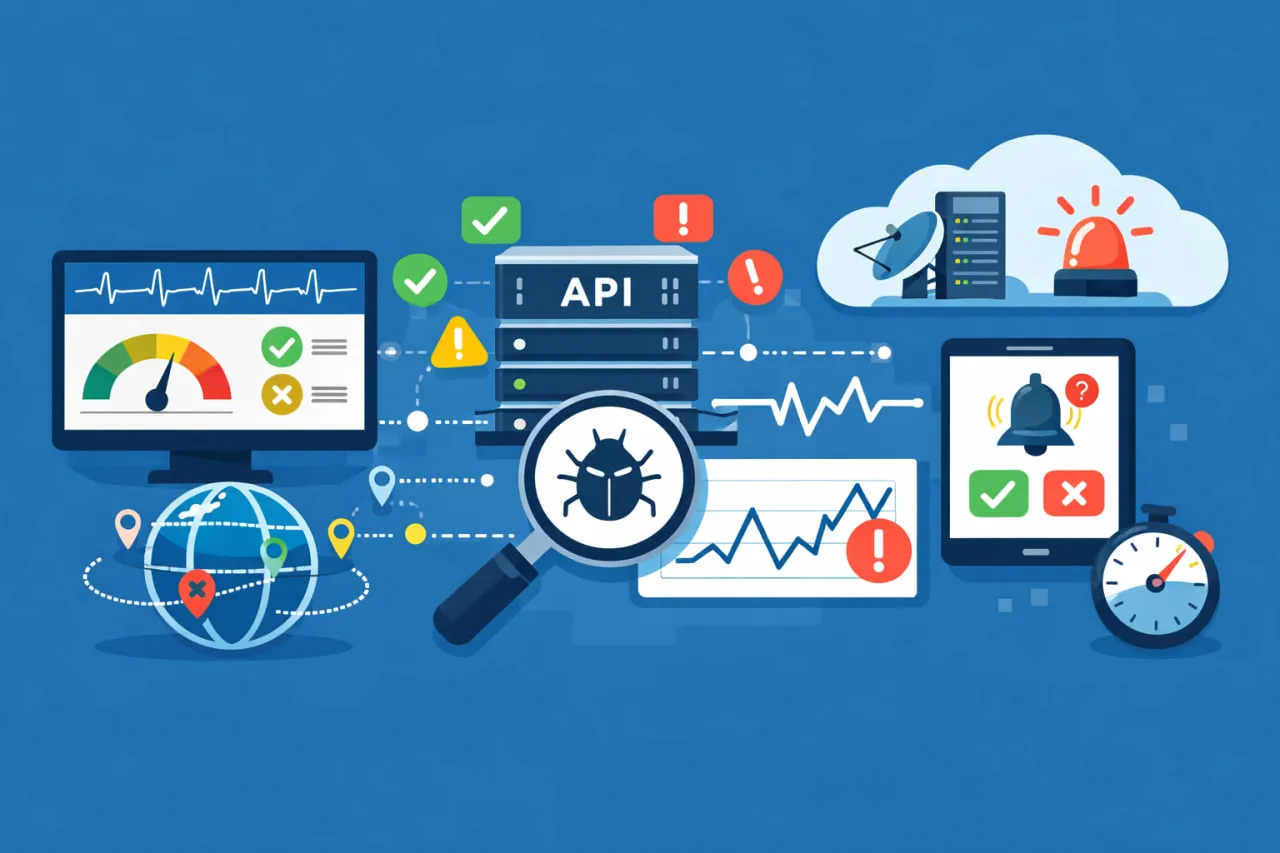
 APIs sit at the center of modern digital infrastructure. Mobile applications, SaaS platforms, microservices, and third party integrations all depend on APIs to exchange data and execute business logic in real time. When an API becomes unavailable, slows down, or returns incorrect data, users feel it immediately. Transactions fail. Dashboards stop updating. Logins break. Revenue and trust are affected within minutes.
This is why API status monitoring is no longer optional. It is the continuous process of externally verifying that your APIs are available, responsive, and functioning as expected. It does not stop at checking whether a server responds. It validates endpoints, authentication flows, response codes, and even payload content to ensure the API works from the user’s perspective.
Many teams rely on internal logs or public status pages to track API health. The problem is that these methods are reactive. By the time a status page reflects an incident, customers may already be experiencing disruption. Proactive monitoring closes that gap by detecting issues in real time and triggering alerts before they escalate.
Effective API status monitoring should help you:
- Detect downtime before customers report it;
- Validate API responses, not just HTTP status codes;
- Track performance trends across locations;
- Support SLA commitments with reliable data.
For organizations that need complete visibility across endpoints and workflows, a dedicated external platform like advanced API monitoring software provides the depth and reliability required for modern environments.
What Is API Status Monitoring?
API status monitoring is the continuous, automated process of checking whether an API is available, responsive, and functionally correct from an external point of view. It verifies that API endpoints are reachable, that they return the expected HTTP status codes, and that the response data matches predefined validation rules.
At a basic level, some teams equate API status monitoring with uptime checks. However, true monitoring goes much deeper than confirming that an endpoint returns a 200 OK response. A healthy API must also:
- Respond within acceptable performance thresholds;
- Authenticate requests correctly;
- Return valid and complete JSON or XML payloads;
- Execute business logic as expected;
- Support multi-step workflows when required.
For example, an API might return a 200 status code but still deliver malformed data or incomplete results. Without response validation, this issue could go unnoticed while users experience errors in applications that depend on the API.
Example: Simple API Status Check Using cURL
A quick way to understand API status monitoring is to simulate a basic external request. For example, an engineer might manually verify an API endpoint using a cURL command:
-H "Authorization: Bearer YOUR_API_TOKEN" \

-H "Accept: application/json"
A successful response might look like:
{

"status": "success",

"orders": [

{

"id": 10231,

"status": "processed"

}

]
}
In a monitoring platform, this same request can be automated and executed continuously. The monitoring system validates that:
- The endpoint responds successfully
- The HTTP status code returns
200 OK - Required fields exist in the response payload
- The response time remains within performance thresholds
If any validation rule fails, the system triggers an alert so engineers can investigate immediately.
It is also important to distinguish API status monitoring from related concepts. In API availability monitoring, the focus is primarily on uptime and reachability. In broader monitoring strategies, observability tools may analyze logs and traces internally. API status monitoring, on the other hand, emphasizes external, real world validation of endpoints and functionality.
If you need a deeper foundational overview, our guide on what API monitoring is and how it works explains the broader monitoring landscape and how status tracking fits into it.
When implemented correctly through a platform built for external API performance and availability monitoring, teams gain continuous insight into endpoint health, performance metrics, and failure conditions across environments and geographic regions. This ensures that issues are identified before they affect users or violate SLAs.
Why API Status Monitoring Is Critical for Modern Applications
Modern applications are no longer monolithic systems running in a single environment. They are distributed ecosystems made up of microservices, third party APIs, cloud infrastructure, and mobile clients. In this architecture, APIs are the connective tissue. If one API fails, entire workflows can break.
In a microservices environment, services constantly communicate with one another through APIs. A failure in a single endpoint can cascade into system-wide degradation. Without continuous status monitoring, teams may not detect subtle failures until they escalate into visible outages.
Third-party dependencies add another layer of risk. Payment gateways, authentication providers, shipping services, and analytics platforms are often external APIs outside your direct control. If one of these services becomes unavailable or slows down, your application may fail even though your own infrastructure is healthy. This makes third-party API reliability monitoring essential for maintaining service continuity.
API status monitoring is also directly tied to business performance. When APIs fail, organizations face:
- Lost transactions and revenue
- Increased support tickets
- SLA violations and penalties
- Damaged customer trust
Even performance degradation can be costly. Slow APIs increase page load times, delay mobile app responses, and frustrate users. Continuous API response time monitoring and real time error detection allow teams to respond before performance issues become customer facing incidents.
For SaaS providers and enterprise platforms, contractual SLAs demand measurable uptime and performance benchmarks. Accurate external status monitoring provides objective data to validate compliance and defend service commitments.
Real-World Example: When an API Failure Cascades Across Systems
API outages rarely affect only a single endpoint. In modern distributed architectures, failures can propagate quickly across services.
For example, imagine an e-commerce platform that depends on multiple APIs:
- Authentication API validates user sessions.
- Inventory API confirms product availability.
- Payment gateway API processes transactions.
If the inventory API begins returning incomplete responses, the checkout system may fail to confirm product availability. As a result:
- Checkout requests fail;
- Customers abandon carts;
- Support tickets increase rapidly.
From the user’s perspective, the entire platform appears broken even though the core application infrastructure remains operational.
External API status monitoring would detect the issue by validating response payloads rather than relying only on HTTP status codes. This allows engineering teams to identify the failing dependency quickly and restore service before widespread disruption occurs.
API Status Monitoring and Reliability Engineering (SLIs, SLOs, and Error Budgets)
Modern engineering teams often align API monitoring with reliability engineering frameworks such as Service Level Indicators (SLIs), Service Level Objectives (SLOs), and error budgets.
SLIs represent measurable indicators of API health, such as:
- Availability percentage;
- Response time thresholds;
- Error rates;
- Successful request ratios.
SLOs define the reliability targets that services must maintain. For example:
- 9% API availability;
- 95th percentile latency under 500 ms;
- Error rate below 0.1%.
Monitoring systems continuously measure SLIs against these SLO targets. When performance degrades and begins consuming the allowed error budget, engineering teams can prioritize remediation before reliability commitments are violated.
Integrating API status monitoring with reliability engineering practices ensures that monitoring data directly supports SLA commitments and operational decision making.
Ultimately, API status monitoring protects more than infrastructure. It protects user experience, revenue streams, and brand reputation. In distributed environments, reactive monitoring is not enough. Proactive, external validation ensures that APIs remain reliable under real world conditions across global monitoring locations.
What Should API Status Monitoring Actually Track?
Effective API status monitoring goes beyond simple uptime checks. To truly understand API health, monitoring must evaluate multiple technical and functional layers. A green status indicator alone does not guarantee that users are receiving correct or timely responses.
Here are the core elements that comprehensive monitoring should track:
1. Uptime and Availability
At the foundation, monitoring must verify that endpoints are reachable and responsive. This includes detecting network failures, DNS issues, and server outages. Consistent monitoring of API endpoints ensures that each critical route remains accessible at all times.
2. Response Time and Latency
Availability is not enough if performance degrades. Monitoring should measure how long APIs take to respond and whether they stay within acceptable thresholds. Tracking API response time and performance trends across monitoring locations helps teams identify bottlenecks before they impact users.
3. HTTP Status Codes
Status codes provide immediate insight into failure types. Spikes in 4xx or 5xx responses can indicate authentication issues, application errors, or backend instability. Continuous API error monitoring ensures that these patterns are detected early.
4. Response Content Validation
An API can return a 200 OK status and still deliver invalid or incomplete data. Advanced status monitoring validates JSON or XML responses against expected values, schema rules, or keywords. This protects against silent failures that traditional uptime checks would miss.
Example JSON validation rule:
{

"path": "$.status",

"expected_value": "success"

}
This rule checks that the status field exists in the response and contains the expected value. If the API returns an unexpected value such as “error” or “null”, the monitoring system flags the check as failed even if the HTTP status code is successful.
This type of validation helps detect silent functional failures, where APIs appear healthy but return incorrect data.
5. Authentication and Authorization
Many APIs require tokens, headers, or session credentials. Monitoring must simulate real authentication workflows to ensure login and access controls function correctly.
6. Multi Step Transactions
Some API workflows require multiple requests executed in sequence. Monitoring platforms can replicate these workflows to validate complete business transactions.
Example workflow:
- Authenticate user
- Retrieve account data
- Submit transaction request
Example sequence:
POST /auth/login

Response:

{

"token": "abc123xyz"

}
Next request:
GET /accounts

Authorization: Bearer abc123xyz
Monitoring tools capture the authentication token from the first request and automatically inject it into subsequent calls. This ensures the entire API workflow functions correctly from login through transaction completion.
API Status Monitoring vs API Status Pages
One of the main reasons search results for API status monitoring are confusing is that many pages focus on public API status dashboards. While status pages are useful for communication, they are not the same as proactive monitoring.
An API status page is typically a public facing dashboard that displays current system health. It shows whether services are operational, degraded, or experiencing outages. However, status pages are usually updated after an incident has already been detected and confirmed internally.
API status monitoring works differently. It is proactive and automated. Instead of reporting incidents after they occur, it continuously tests endpoints from external locations and triggers alerts the moment a failure or performance degradation is detected.
The differences are clear:
- Status pages communicate incidents
- Monitoring detects incidents
- Status pages are reactive
- Monitoring is proactive
- Status pages show high level service state
- Monitoring validates functionality, performance, and data integrity
Relying solely on a public dashboard creates a visibility gap. Customers may encounter issues before the status page reflects a problem. External monitoring closes that gap by identifying outages, latency spikes, or functional failures in real time.
Organizations that prioritize uptime typically combine both approaches. They use monitoring to detect and diagnose issues quickly, then update status pages for transparency. Implementing a robust external solution for real-time API status tracking and validation ensures that incidents are identified early and resolved before widespread disruption occurs.
API Status Monitoring Tools: SaaS vs Open Source vs Observability Platforms
Organizations can implement API status monitoring using several different types of tools. Each approach offers different trade-offs in terms of control, scalability, and operational complexity.
SaaS Monitoring Platforms
Dedicated SaaS monitoring platforms provide external monitoring infrastructure, global test locations, and built-in alerting capabilities. These platforms are designed to continuously validate API availability and performance without requiring teams to manage monitoring infrastructure themselves.
Advantages include:
- Global monitoring locations;
- Built-in alerting and reporting;
- Rapid deployment and configuration;
- SLA-ready uptime tracking.
SaaS solutions are commonly used by teams that need reliable external visibility into API availability and user-facing performance.
Open Source Monitoring Tools
Some organizations choose open-source monitoring solutions such as Prometheus, Grafana, or custom scripts. These tools allow teams to build flexible monitoring systems tailored to their infrastructure.
However, open-source solutions typically require teams to manage:
- Infrastructure hosting;
- scaling and maintenance;
- alerting configuration;
- monitoring reliability.
While open-source tools provide flexibility, they often require significant operational effort to replicate the external monitoring capabilities of dedicated platforms.
Observability Platforms
Full observability platforms combine metrics, logs, and traces to provide deep insight into internal system behavior. These tools are useful for diagnosing issues once they occur.
However, observability platforms typically rely on internal instrumentation rather than external validation. For API status monitoring, many organizations combine observability tools with external monitoring solutions to ensure both internal diagnostics and user-facing reliability.
Choosing the Right API Monitoring Approach
| Monitoring Approach | Best For | Advantages | Limitations |
| SaaS Monitoring Platforms | External uptime and performance monitoring | Global test locations, easy setup, built-in alerting | Less infrastructure control |
| Open Source Monitoring | Custom monitoring pipelines | Flexible configuration, no licensing costs | Requires infrastructure management |
| Observability Platforms | Deep system diagnostics | Logs, traces, and metrics for root cause analysis | Limited external validation |
| Hybrid Approach | Large-scale distributed systems | Combines external monitoring with internal observability | Higher operational complexity |
Many engineering teams adopt a hybrid strategy, using external monitoring platforms for availability validation while relying on observability tools for deeper debugging.
Best Practices for Effective API Status Monitoring
Implementing API status monitoring is not just about turning on checks. To get reliable, actionable insight, monitoring must be configured strategically. Poorly configured checks can either miss critical failures or generate excessive noise.
The following best practices help ensure meaningful visibility:
Monitor from Multiple Geographic Locations
API performance can vary significantly across geographic regions due to network routing, cloud infrastructure differences, and regional service dependencies. Monitoring from multiple locations allows teams to detect localized outages that might not be visible from a single monitoring point.
Multi-location monitoring also enables engineers to compare regional performance metrics and identify issues such as:
- CDN routing problems;
- regional infrastructure failures;
- ISP level latency spikes;
- cloud provider availability issues.
This approach provides a more accurate representation of real user experience across global markets.
Set Intelligent Alert Thresholds
Alerting on every minor fluctuation creates fatigue. Instead, define realistic performance thresholds and configure alerting rules to ensure timely notifications without unnecessary noise. Alerts should reflect true service impact, not temporary micro delays.
Validate the Payload, Not Just the Status Code
A 200 response does not guarantee functional success. Monitoring should validate specific fields, values, or schema elements within the response body. This prevents silent data corruption or incomplete responses from going unnoticed.
Monitor Third Party APIs Separately
External services introduce independent risk. Monitoring third-party APIs independently helps quickly identify whether a failure originates within your infrastructure or from an external dependency
Track SLA Metrics Continuously
Availability percentages, response times, and error rates should be measured over time. Historical reporting supports SLA compliance and trend analysis. Broader API observability tools and strategies can complement status monitoring by adding deeper insight into logs and traces when troubleshooting is required.
When these practices are combined with a reliable external monitoring platform, API status tracking becomes a proactive defense mechanism rather than a passive reporting tool. Proper configuration ensures teams receive early warning signals without unnecessary alert noise.
Common API Monitoring Failures and What They Mean
| Monitoring Alert | Possible Cause | Recommended Action |
| HTTP 5xx errors | Server-side application failure | Inspect backend logs and recent deployments |
| Increased response time | Database latency or network congestion | Analyze infrastructure metrics and routing |
| Authentication failures | Expired tokens or incorrect credentials | Refresh authentication configuration |
| Invalid response payload | Application logic error or incomplete data | Validate response schema and business logic |
| Regional latency spikes | CDN or routing issues | Compare monitoring results across locations |
This type of troubleshooting visibility helps engineering teams diagnose API issues faster.
How to Set Up API Status Monitoring
Setting up API status monitoring requires a structured approach to ensure both technical accuracy and business relevance. The goal is not simply to test endpoints, but to replicate real usage conditions and validate expected outcomes.
A practical setup process typically includes the following steps:
1. Identify Critical Endpoints
Start by listing the APIs that directly impact user experience, transactions, authentication, or integrations. Prioritize revenue-generating and customer-facing services.
2. Configure Request Parameters
Define HTTP methods, headers, authentication tokens, and request bodies. Accurate configuration ensures monitoring simulates real application behavior. Detailed instructions for configuring REST Web API tasks can help ensure endpoints are properly defined.
Example REST monitoring configuration:
endpoint: https://api.example.com/v1/orders

method: GET

headers:

Authorization: Bearer ${API_TOKEN}

Accept: application/json

validation:

status_code: 200

max_response_time_ms: 2000

json_path:

$.status: success

check_frequency: 1 minute

locations:

- us-east

- europe-west

- asia-pacific
This configuration continuously verifies endpoint availability, validates the response payload, and checks performance across multiple geographic monitoring locations.
3. Add Response Validation Rules
Set conditions that validate status codes, response times, and specific JSON or XML fields. This prevents silent functional failures. If changes are required later, you can follow guidance on adding or editing REST Web API monitoring tasks to refine validation logic.
4. Define Alerting and Escalation
Configure alerts based on downtime thresholds, error rates, or latency spikes. Integrations with notification systems ensure the right teams are informed immediately.
5. Deploy Global Monitoring
Run checks from multiple geographic locations to detect regional performance issues and network disruptions.
For organizations seeking a comprehensive solution, a platform designed for external API uptime and performance monitoring simplifies setup while providing built in validation, alerting, and reporting capabilities.
When implemented correctly, API status monitoring becomes an automated early warning system that protects user experience and business continuity.
API Monitoring Troubleshooting Playbook
When monitoring alerts trigger, teams need a structured approach to diagnose the root cause quickly.
A typical troubleshooting workflow includes:
1. Verify the monitoring result
Confirm that the failure is not caused by configuration errors or expired authentication tokens.
2. Check HTTP response codes
Status codes provide the first indication of failure type:
- 4xx errors typically indicate authentication or request issues
- 5xx errors suggest server-side failures
3. Analyze response time trends
If latency increases before failures occur, the issue may stem from infrastructure bottlenecks or database performance.
4. Compare monitoring locations
If failures occur only in specific regions, the issue may involve routing problems, CDN configuration, or regional infrastructure outages.
5. Review recent deployments
Many API incidents occur after code releases or configuration changes. Reviewing recent deployments can quickly reveal the root cause.
A structured troubleshooting process helps teams move from alert detection to root-cause resolution more efficiently.
How Dotcom-Monitor Supports Advanced API Status Monitoring
Effective API status monitoring requires more than simple uptime checks. It demands external validation, flexible configuration, and reliable alerting that reflects real user experience. This is where Dotcom-Monitor’s platform is built to support modern API environments.
Dotcom-Monitor enables teams to monitor APIs from multiple geographic locations, ensuring that availability and performance are measured from an external perspective. This helps identify regional outages, routing issues, and latency spikes that internal tools may overlook.
The platform supports comprehensive validation capabilities, including:
- Monitoring REST and SOAP APIs
- Verifying HTTP status codes
- Validating JSON and XML response content
- Configuring authentication workflows
These capabilities allow teams to detect not only downtime, but also functional failures that may otherwise remain hidden behind successful status codes. Built-in alerting ensures that incidents trigger notifications immediately, helping teams detect and respond to incidents faster.
Historical reporting also provides measurable data for SLA tracking and performance analysis. Teams can review trends, identify recurring bottlenecks, and strengthen long-term reliability strategies.
For organizations that need deeper visibility and proactive control, implementing a purpose-built solution like Dotcom-Monitor’s API monitoring platform provides external status validation, performance tracking, and configurable alerting within a single system. Reviewing how Dotcom-Monitor approaches API status monitoring can help you determine whether it aligns with your reliability and SLA objectives.
Conclusion
API status monitoring is not simply about knowing whether an endpoint responds. It is about ensuring that APIs are available, responsive, and functionally correct under real world conditions. In distributed systems powered by microservices and third party integrations, even small failures can cascade into significant business impact.
Relying solely on internal logs or public status dashboards creates blind spots. True reliability requires continuous external validation, intelligent alerting, and detailed response verification. When monitoring includes uptime checks, latency tracking, error detection, and payload validation, teams gain a complete picture of API health.
By implementing structured monitoring best practices and leveraging a purpose-built platform like Dotcom-Monitor’s API monitoring solution, organizations can proactively detect incidents, protect SLAs, and maintain consistent user experience across regions and environments.
API reliability is directly tied to customer trust and revenue continuity. Proactive monitoring ensures your systems remain dependable even as architectures grow more complex.