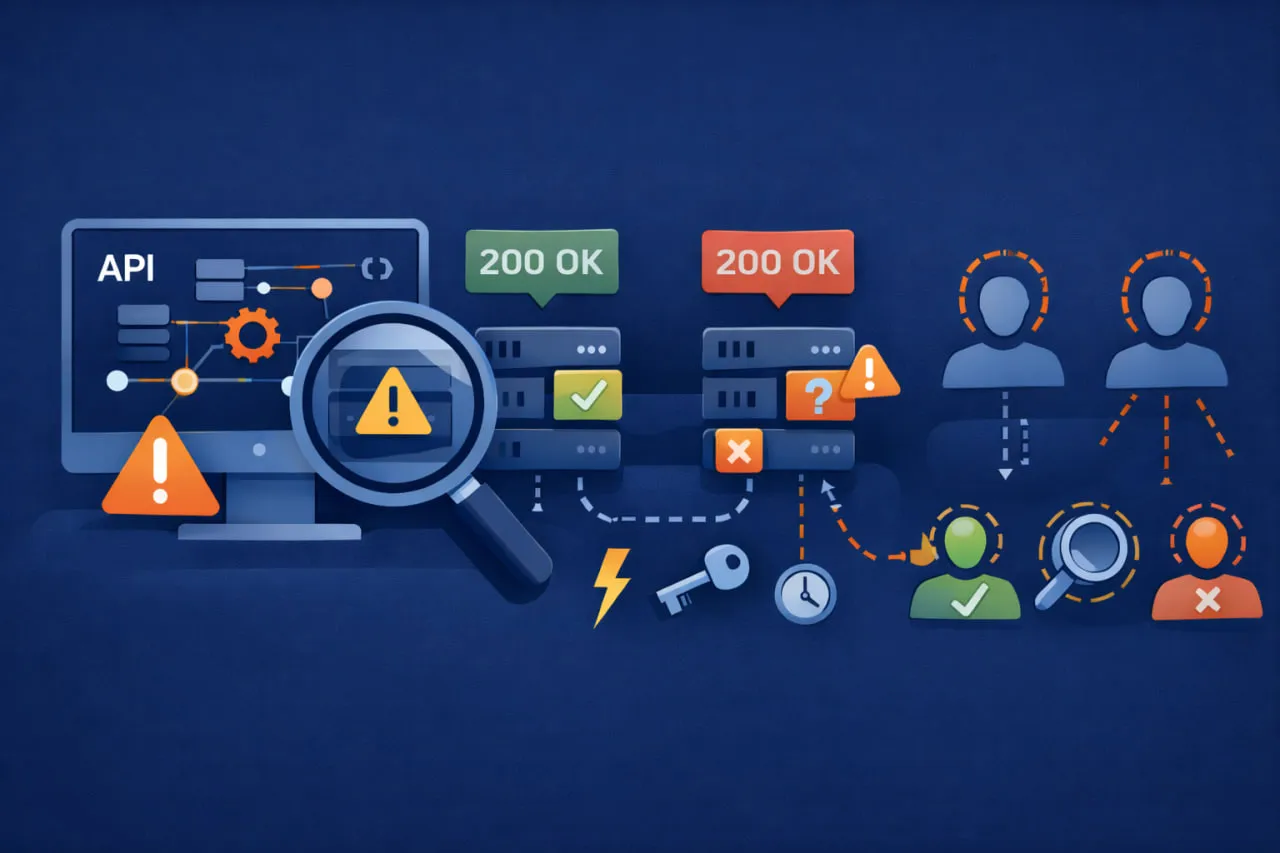
 APIs sit at the center of modern digital systems. They power mobile apps, enable partner integrations, and connect internal services across distributed architectures. When an API fails, the impact is immediate: broken user journeys, stalled transactions, and downstream systems that quietly stop working. That’s why API health monitoring is now a core reliability practice for modern engineering teams.
The problem is that “API health” is often defined too narrowly.
In many environments, API health monitoring is reduced to a single health check endpoint. If that endpoint responds with a 200 OK, the API is considered healthy. This approach works for detecting hard outages, but it fails to capture what actually matters in production.
In reality, APIs can appear “up” while still being broken. Common examples include:
- Successful responses that return incomplete or incorrect data
- Authentication flows that fail after token expiration
- Performance degradation in specific regions or networks
- Downstream or third-party dependencies timing out intermittently
From an end-user or consumer perspective, the API is unhealthy, even though internal checks say otherwise.
This gap is why effective API health monitoring goes beyond basic availability. A healthy API must be:
- Reachable from where users and systems actually call it
- Performant enough to meet latency expectations
- Functionally correct, returning the right data every time
In this guide, we’ll explore how modern teams define and monitor API health in production. We’ll look at how silent failures happen, why synthetic monitoring is essential, and how API health monitoring complements API observability by validating real outcomes — not just internal signals.
What Is API Health Monitoring?
At its core, API health monitoring is the practice of continuously verifying that an API is working as intended in production, not just that it’s running, but that it’s delivering correct and reliable outcomes for consumers.
This distinction is important because API health is often confused with API availability. An API can be technically “up” while still failing in ways that matter to users and dependent systems.
A more complete definition of API health monitoring answers three fundamental questions:
- Can the API be reached?
This includes DNS resolution, network connectivity, and successful request delivery from different locations. - Is the API responding fast enough?
Latency, time-to-first-byte, and consistency under load all influence whether an API feels healthy to consumers. - Is the API returning the correct response?
Status codes alone don’t guarantee correctness. Response structure, required fields, and business logic all matter.
Effective API health monitoring validates all three, continuously and externally, to reflect real usage conditions.
It’s also important to understand what API health monitoring is not. It’s not limited to a single endpoint or a one-time check. It doesn’t stop at confirming a process is alive. Instead, it focuses on the API’s behavior across its most critical paths, including authenticated requests and dependent services.
This broader approach becomes especially valuable in distributed systems, where failures are often partial and intermittent. A database slowdown, an expired token, or a misconfigured dependency can degrade an API long before it goes completely offline.
This is where API health monitoring complements API observability. Observability tools help teams understand why something is happening by analyzing logs, metrics, and traces. Health monitoring, on the other hand, confirms whether the API is actually usable from the outside.
Together, they form a more accurate and actionable view of API reliability.
Why Health Endpoints Alone Aren’t Enough
Health check endpoints play an important role in modern systems. They help orchestration platforms, load balancers, and internal services determine whether an application process is running and able to accept traffic. Used correctly, they can prevent routing traffic to completely failed instances.
The problem is that /health endpoints were never designed to represent full API health, especially from a consumer’s point of view.
Most health endpoints are intentionally lightweight. They often confirm only that the service is alive and, in some cases, that a few critical dependencies are reachable. While this is useful for internal resilience, it leaves several common failure modes undetected.
For example, a health endpoint can return 200 OK even when:
- Authentication tokens expire and protected endpoints start returning
401or403 - A downstream service returns malformed or partial data
- Business logic changes break response payloads while keeping schemas intact
- Performance degrades in specific regions due to routing or network issues
In each of these cases, the API is technically “up,” but functionally broken.
Another limitation is scope. Health endpoints typically represent a single check, not the full set of interactions that real users depend on. They don’t validate multi-step workflows, chained requests, or transactional flows where one failure breaks the entire experience.
There’s also a visibility gap. Health endpoints usually run inside the same environment as the API itself. They don’t reveal problems caused by DNS resolution, TLS negotiation, regional routing, or edge-network behavior, all of which directly affect external consumers.
This is why many teams experience so-called “silent failures”: incidents where dashboards look green, but users are already impacted.
To close that gap, teams need to monitor APIs from the outside, simulate real requests, and validate outcomes, not just availability. This is where synthetic checks and targeted monitoring scenarios provide value that internal health endpoints simply can’t.
When combined with broader API observability, external API health monitoring helps teams catch issues earlier, reduce mean time to detection, and avoid relying on user reports as their first signal.
The Three Dimensions of True API Health
To understand whether an API is truly healthy in production, teams need to look beyond a single signal. Real API health is multidimensional. It reflects how the API behaves under real usage conditions, across networks, regions, and dependencies.
A practical way to frame API health monitoring is through three core dimensions:
- Availability
- Performance
- Correctness
Each dimension answers a different question, and all three are required to detect issues early and reliably.
Availability: Can the API Be Reached?
Availability is the most basic, and most commonly measured, dimension of API health. At a minimum, it answers whether an API endpoint can be reached and returns a response.
However, availability in production is more nuanced than “up or down.”
An API may be reachable from inside your infrastructure while being unavailable to users in specific regions. DNS failures, TLS issues, routing problems, or ISP-level disruptions can prevent requests from reaching the API, even though internal checks pass.
Effective availability monitoring therefore focuses on:
- External reachability, not just internal service health
- Multi-location testing to confirm issues are widespread
- Verifying response success, not just socket-level connectivity
This is why external synthetic checks are essential. They validate availability from the same networks your users and partners rely on, helping teams distinguish between localized glitches and real outages.
Availability monitoring also works best when paired with clear alert conditions. A single failure from one location may not warrant action, but repeated failures across regions usually do.
Performance: Is the API Fast Enough?
An API that responds slowly is often just as damaging as one that doesn’t respond at all. Performance is a critical health signal because latency directly affects user experience, application stability, and downstream systems.
Basic averages don’t tell the full story. In production environments, performance issues tend to be intermittent and unevenly distributed. Averages can hide spikes that break time-sensitive workflows or cause cascading failures.
Effective API health monitoring evaluates performance by:
- Tracking response times over time, not just point-in-time checks
- Focusing on higher percentiles (such as p90 or p95)
- Comparing performance across regions and endpoints
Performance degradation is often an early indicator of deeper issues, overloaded dependencies, inefficient queries, or failing third-party services. Catching these trends early allows teams to respond before availability is affected.
Monitoring performance externally also provides a more accurate view of what consumers experience, complementing internal metrics collected through instrumentation.
Correctness: Is the API Returning the Right Data?
Correctness is the most overlooked (and most critical) dimension of API health.
Many API failures don’t result in error codes. Instead, the API responds successfully but returns incorrect, incomplete, or unexpected data. These issues often go undetected until users complain or downstream systems break.
Examples of correctness failures include:
- Missing or null fields in responses
- Schema changes that break consumers
- Business rules no longer being enforced
- Stale or inconsistent data from dependencies
This is where status-code-based monitoring falls short. A 200 OK response doesn’t guarantee the API is behaving correctly.
To monitor correctness, teams need to validate responses using assertions, such as:
- Required fields and data types
- Expected values or ranges
- Logical conditions tied to business rules
By validating what the API returns, not just that it responds, teams can detect silent failures that would otherwise slip through traditional monitoring.
Correctness monitoring is a foundational capability of mature API monitoring tools, especially in environments where APIs support revenue-critical or customer-facing workflows.
Detecting Silent Failures with Synthetic API Monitoring
Silent failures are one of the most costly, and hardest to detect, classes of API issues. They occur when an API continues to respond successfully, but no longer behaves as expected. From a monitoring perspective, everything looks healthy. From a user’s perspective, something is clearly broken.
This is where synthetic API monitoring becomes essential to effective API health monitoring.
Synthetic monitoring works by executing predefined API requests at regular intervals from external locations. These requests are designed to simulate real usage patterns, including authentication, headers, payloads, and expected responses. Instead of relying on internal signals alone, teams can validate what actually happens when an API is called from the outside.
The key advantage of synthetic API monitoring is intent. You’re not just checking whether an endpoint is reachable, you’re verifying that it behaves correctly.
Synthetic checks are especially effective for detecting issues such as:
- APIs returning valid status codes with incorrect payloads
- Partial outages affecting only certain regions or networks
- Authentication failures after token expiration
- Latency spikes that don’t trigger internal alarms
Because synthetic checks are controlled and repeatable, they provide consistent baseline data. This makes it easier to identify regressions after deployments, configuration changes, or dependency updates.
Another benefit is isolation. When an issue occurs, synthetic monitoring helps teams determine whether the problem lies with the API itself, the network path, or a downstream dependency. This reduces investigation time and improves incident response.
Synthetic monitoring doesn’t replace logs, metrics, or traces. Instead, it complements them by answering a simpler, but crucial question: Can real consumers successfully use the API right now? When paired with broader API observability, synthetic checks provide an external confirmation layer that internal instrumentation can’t fully replicate.
For teams managing REST-based services, synthetic monitoring is often the missing link between theoretical uptime and real reliability. It validates availability, performance, and correctness in a single workflow, making it a cornerstone of modern API health monitoring strategies.
Monitoring Authenticated & Multi-Step APIs
Most production APIs are not publicly accessible. They rely on authentication, custom headers, and chained requests to protect data and enforce access control. As a result, effective API health monitoring must account for how real consumers authenticate and interact with the API, not just whether an unauthenticated endpoint responds.
Monitoring Authenticated APIs Without False Alerts
Authenticated APIs introduce additional failure modes that simple checks can’t catch. Tokens can expire, credentials can be rotated, or authorization scopes can change unexpectedly. When this happens, the API may remain available but become unusable for legitimate clients.
To monitor authenticated APIs reliably, teams need to:
- Include authentication headers (API keys, bearer tokens, OAuth tokens) in monitoring requests
- Validate that authentication succeeds before testing business logic
- Monitor token refresh or renewal flows where applicable
Without these steps, monitoring can generate false positives, or worse, miss real authentication failures entirely.
This is why many teams rely on scripted API checks that mirror real client behavior. Using properly configured REST Web API tasks, monitoring systems can authenticate requests, validate responses, and ensure protected endpoints remain usable in production — even as credentials and tokens change over time.
Multi-Step and Transactional API Monitoring
Many critical API interactions span multiple requests. A single endpoint may work in isolation, but the overall workflow fails when steps are combined.
Common examples include:
- Login → token generation → authenticated request
- Create resource → retrieve resource → validate response
- Pagination, filtering, or conditional requests
Multi-step API monitoring allows teams to test these flows as a single transaction. Each step depends on the previous one, mirroring how real systems interact with the API. If any step fails (authentication, data creation, or response validation) the monitor fails, providing a clearer signal of functional health.
This approach is particularly valuable after deployments or configuration changes, where individual endpoints appear healthy but complete workflows break. By adding or editing REST Web API tasks to reflect real user paths, teams can detect these issues before they impact customers.
When implemented correctly, authenticated and multi-step monitoring reduces blind spots in API health monitoring and ensures alerts reflect real-world impact — not just isolated technical failures.
API Health Monitoring in Production: SLOs, Alerts, and Noise Reduction
Once teams begin monitoring availability, performance, and correctness, the next challenge is operationalizing those signals. Without clear objectives and alerting discipline, even the best API health monitoring setup can become noisy and hard to act on.
This is where Service Level Objectives (SLOs) play a critical role.
Defining SLOs for API Health
SLOs translate raw monitoring data into reliability targets that reflect real business impact. Instead of asking “Did the API fail?”, SLOs help teams answer, “Did the API meet expectations for users?”
Effective API SLOs typically combine multiple health signals, such as:
- Availability targets (for example, successful responses over time)
- Performance thresholds (p95 or p99 latency)
- Correctness rates (responses that meet validation rules)
By defining SLOs around these dimensions, teams can track API health in a way that aligns with customer experience, not just infrastructure status.
Alerting on Impact, Not Noise
One of the most common mistakes in API monitoring is alerting on every failure. Single-location blips, transient network issues, or short-lived spikes can trigger alerts that don’t require action.
Production-ready API health monitoring reduces noise by:
- Requiring failures from multiple locations before triggering alerts
- Using consecutive failure thresholds instead of single events
- Differentiating warning-level alerts from critical incidents
This approach ensures alerts reflect real outages or meaningful degradation, not isolated anomalies.
Complementing Observability with External Signals
Internal logs and metrics are essential for diagnosing issues, but they don’t always reveal whether users are affected. External API health monitoring closes this gap by validating real outcomes from outside your infrastructure.
When paired with API observability, health monitoring provides both sides of the reliability equation:
- Observability explains why something happened
- Health monitoring confirms whether the API actually works
Together, they reduce mean time to detection, improve incident response, and help teams make informed decisions about reliability trade-offs.
Monitoring Third-Party APIs as Part of Your API Health
Modern APIs rarely operate in isolation. Payment providers, messaging services, identity platforms, and data vendors are often embedded directly into core application workflows. When these third-party APIs degrade or fail, your API’s health is affected, even if your own infrastructure is functioning normally.
This is why third-party dependencies must be treated as part of your overall API health monitoring strategy.
From a user’s perspective, it doesn’t matter where the failure originates. If a payment request times out or an identity provider fails to respond, the experience is broken. Relying solely on vendor status pages or post-incident notifications leaves teams reacting too late.
Effective third-party API monitoring focuses on:
- Verifying availability and latency from your application’s perspective
- Detecting partial outages that vendors may not publicly acknowledge
- Confirming that responses meet functional expectations
By monitoring third-party endpoints with the same rigor as internal APIs, teams gain independent visibility into vendor performance.
External monitoring also provides concrete data during incidents. Instead of guessing whether an issue is internal or external, teams can quickly determine whether failures correlate with a specific dependency. This shortens troubleshooting time and improves communication with stakeholders.
Over time, third-party API monitoring supports more than just incident response. Historical performance data can be used for:
- SLA verification and vendor accountability
- Capacity planning and risk assessment
- Justifying escalations or contract discussions
When combined with broader API uptime monitoring, this approach helps teams understand how external dependencies influence overall service reliability, and ensures API health reflects real-world conditions, not just internal assumptions.
API Health Monitoring Checklist
As APIs move into production and scale, having a consistent checklist helps teams avoid blind spots and maintain reliable monitoring coverage. While every system is different, effective API health monitoring typically includes the following core elements.
Availability
- Monitor critical endpoints from multiple external locations
- Confirm successful responses, not just network connectivity
- Distinguish isolated failures from widespread outages
Performance
- Track response times over time, not just instant checks
- Focus on higher percentiles (p90, p95) instead of averages
- Compare performance across regions and endpoints
Correctness
- Validate response payloads, not only status codes
- Assert required fields, data types, and expected values
- Check business logic where applicable
Authentication & Workflows
- Monitor authenticated endpoints with real headers and tokens
- Test multi-step and transactional API flows
- Update monitoring logic after auth or schema changes
Alerting & Operations
- Require multiple failures before triggering alerts
- Route alerts by severity and impact
- Review and tune thresholds regularly
This checklist is not a one-time exercise. API health monitoring should evolve alongside your API as usage patterns, dependencies, and risk profiles change.
For teams ready to move beyond basic health checks, implementing structured external monitoring is often the next step toward more reliable, user-focused API operations.
When to Move from Health Checks to Full API Health Monitoring
Basic health check endpoints are a good starting point, but they aren’t designed to scale with growing API complexity or business impact. As APIs become more critical to users, partners, and revenue, teams need clearer signals that reflect real-world reliability.
There are several indicators that it’s time to move beyond simple health checks.
You may be ready for full API health check if:
- Your API supports customer-facing or revenue-critical workflows
- Authentication or authorization failures have caused incidents in the past
- Users report issues before monitoring alerts trigger
- Performance problems appear intermittently or only in certain regions
- Third-party dependencies influence your API’s behavior
At this stage, relying solely on internal checks creates blind spots. Health check endpoints can confirm that a service is alive, but they can’t validate real user journeys or detect silent failures that occur outside your infrastructure.
Full API health monitoring adds an external validation layer. It continuously tests how the API behaves from the perspective of consumers, using real requests, authentication, and response validation. This shift helps teams detect issues earlier, reduce mean time to detection, and prevent customer-impacting outages.
For teams taking this step, Web API Monitoring becomes the natural next phase. It enables structured monitoring of availability, performance, and correctness across critical endpoints and workflows, without replacing existing observability tools.
Explore our Web API Monitoring software
As the next step toward reliable API health monitoring
Frequently Asked Questions on API Health Monitoring
/health endpoint. API health monitoring, on the other hand, validates whether the API is usable in real-world conditions. It includes external reachability, performance trends, and response correctness, not just process availability.200 OK while delivering incorrect, incomplete, or stale data. Health monitoring detects these silent failures by validating response payloads, required fields, and business rules — not just status codes.