




Import Postman
In 10 minutes
All features
Expert team
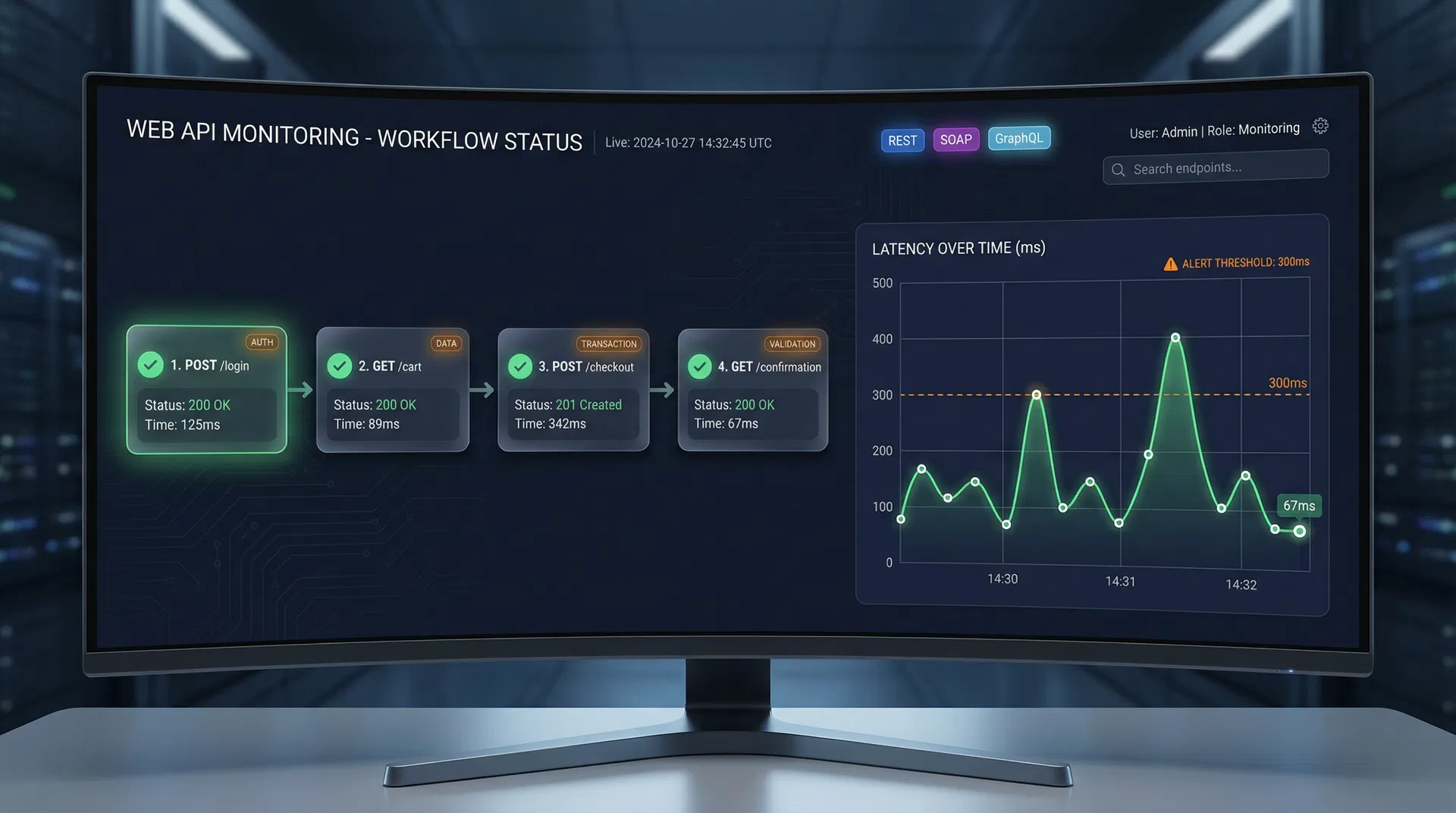
Web API monitoring is the continuous testing of web-based API endpoints to verify availability, performance, and functional correctness across different protocols. Unlike internal API monitoring that focuses on microservices within a private network, web API monitoring validates externally accessible APIs over HTTP/HTTPS, including REST, SOAP, GraphQL, gRPC, WebSockets, and Webhooks.
Web APIs use different protocols depending on integration requirements. REST dominates with over 70% of public APIs using stateless HTTP operations and JSON payloads. SOAP persists in enterprise environments requiring WS-Security and formal contracts, particularly in financial services and healthcare. GraphQL adoption grew 38% year-over-year as of 2024, enabling flexible queries for modern frontends. gRPC optimizes microservice communication with HTTP/2 and Protobuf, reducing latency by up to 7x compared to REST. WebSockets support real-time bidirectional streams for live data feeds. Webhooks deliver event-driven notifications, with platforms like Stripe processing over 1 billion webhook deliveries monthly.
Each protocol requires different monitoring approaches. REST monitors validate JSONPath assertions on JSON responses. SOAP monitors parse WSDL definitions and validate XML with XPath. GraphQL monitors handle nested queries and field-level errors. gRPC monitors decode Protobuf messages. WebSocket monitors track connection persistence and message delivery. Webhook monitors verify delivery attempts and retry logic. Dotcom-Monitor’s API monitoring platform supports all six protocols with protocol-specific assertions, authentication methods, and global location testing.
Percentage of successful API responses over time, tracked per endpoint and globally
Total response time from DNS lookup through SSL handshake to last byte received
Request rate capacity before degradation, measured in requests per second
Percentage of successful API responses over time, tracked per endpoint and globally
POST /api/auth/loginAuthenticate and extract JWT token from response
GET /api/cart?userId=123Retrieve cart contents, validate JSONPath $.items.length > 0
POST /api/checkoutProcess payment, assert $.status == "success" and response time < 2000ms
Dotcom-Monitor supports all major Web API protocols. Choose the right monitoring approach based on your integration architecture.
Protocol | Transport | Data Format | Typical Use Case |
|---|---|---|---|
REST | HTTP/HTTPS | JSON, XML | CRUD resources, stateless operations |
SOAP | HTTP, SMTP | XML | Enterprise services, WS-Security |
GraphQL | HTTP/HTTPS | JSON | Flexible queries, nested data |
gRPC | HTTP/2 | Protobuf | Microservices, low-latency RPC |
WebSockets | TCP (WS/WSS) | Custom, JSON | Real-time feeds, bidirectional streams |
Webhooks | HTTP/HTTPS | JSON | Event notifications, push updates |
Dotcom-Monitor’s Web API monitoring adapts to each protocol’s characteristics. REST and GraphQL monitors validate JSONPath assertions, SOAP monitors parse XML with XPath, gRPC monitors decode Protobuf responses, WebSocket monitors track bidirectional message flows, and Webhook monitors verify delivery and retry logic. All protocols support multi-step workflows, authentication, and global location testing.
Protocol-specific monitoring capabilities tailored to the unique characteristics of REST, SOAP, GraphQL, gRPC, WebSockets, and Webhooks.
Dotcom-Monitor's REST Web API Device checks your REST endpoints for uptime, performance, proper data, and authentication correctness across all HTTP methods.
Full support for GET, POST, PUT, DELETE, PATCH requests with custom headers and form submissions
OAuth 2.0, JWT, Bearer tokens, Basic/Digest authentication, and custom header-based auth
JSONPath assertions validate nested response structures, status codes, and response times
Chain up to 20 API calls with data extraction and variable passing between steps
Certificate validation, expiration tracking, and automated renewal reminders
SOAP monitoring replicates client requests to test SOAP-based web services for availability, errors, and proper content with WSDL import support.
SOAP Wizard imports WSDL URLs and auto-generates valid test parameters for immediate monitoring
XPath assertions validate XML response payloads and SOAP envelope structures
Basic, Digest, and NTLM authentication schemes for Windows and enterprise environments
Application-specific SOAP headers for authentication, payment methods, and routing
Custom DNS resolution modes and IP-to-hostname mapping for private networks
GraphQL monitoring uses the REST Web API Device to send queries and mutations via POST requests, validating nested data structures and field-level errors.
Send GraphQL queries, mutations, and subscriptions with variable injection
JSONPath validates deeply nested GraphQL response structures and detects field-level errors
Track query performance, resolver latency, and complexity metrics
OAuth 2.0, JWT, API keys, and custom GraphQL-specific headers (X-GraphQL-Operation-Name)
Extract data from one query and pass as variables to subsequent mutations
gRPC monitoring leverages HTTP/2 transport and Protobuf decoding to monitor unary, streaming, and bidirectional RPC calls with mTLS support.
Native HTTP/2 protocol support for gRPC service monitoring with multiplexing
Decode Protobuf-encoded responses and validate message structures
Monitor unary, server streaming, client streaming, and bidirectional streaming RPCs
Certificate-based mutual TLS authentication for secure service-to-service communication
Track P50, P95, P99 latency percentiles for performance SLA compliance
WebSocket monitoring tracks persistent bidirectional connections, validates message delivery, and tests reconnection logic for real-time applications.
Monitor WebSocket handshake (HTTP upgrade) and persistent connection uptime
Validate messages sent and received in both client-to-server and server-to-client directions
Test automatic reconnection on disconnect and track reconnection success rates
Measure time between message send and receive for real-time performance
Detect connection timeouts, proxy issues, and silent disconnects
Webhook monitoring validates event-driven push notifications, confirms payload delivery, verifies HMAC signatures, and tracks retry logic.
Confirm webhook payload delivery and track delivery success rates
Validate retry attempts on failure and exponential backoff behavior
Verify HMAC signatures (X-Hub-Signature, X-Webhook-Signature) for security
Validate JSON/XML webhook payloads and event data correctness
Monitor webhook endpoint response times and availability
30+ monitoring locations worldwide with geo-specific routing validation and regional latency tracking.
Instant alerts via email, SMS, Slack, PagerDuty with configurable thresholds and escalation policies.
Uptime percentages, latency trends, certificate expiration reports, and custom scheduled reports.
Real-world monitoring scenarios for each Web API protocol. Dotcom-Monitor adapts to your integration architecture.
REST
Monitor multi-step checkout APIs from product search through payment confirmation. Validate cart operations, inventory checks, payment gateway responses, and order creation. Detect abandoned cart API failures before customers complain.
Example Flow
GET /products → POST /cart/add → POST /checkout → GET /order/status
Key Metrics
SOAP
Monitor legacy SOAP services for B2B data exchange, ERP integration, and financial transactions. Validate WSDL compliance, WS-Security authentication, and XML payload structure. Track SLA compliance for partner-facing APIs.
Example Flow
GetCustomerInfo → ProcessOrder → UpdateInventory
Key Metrics
GraphQL
Monitor GraphQL queries and mutations for single-page applications. Validate nested data structures, field-level errors, and query performance. Detect N+1 query problems and resolver timeouts.
Example Flow
query { user { orders { items { product } } } }
Key Metrics
gRPC
Monitor inter-service gRPC calls in distributed architectures. Validate Protobuf serialization, bidirectional streaming, and service mesh routing. Track latency percentiles for SLO compliance.
Example Flow
UserService.GetProfile → OrderService.CreateOrder
Key Metrics
WebSockets
Monitor WebSocket connections for live dashboards, chat applications, and streaming data. Validate connection establishment, message delivery, and reconnection logic. Detect dropped connections and message loss.
Example Flow
ws://api.example.com/live-feed → message validation
Key Metrics
Webhooks
Monitor webhook delivery for payment processors, CRM integrations, and third-party services. Validate payload structure, retry logic, and signature verification. Track delivery success rates and latency.
Example Flow
POST /webhooks/payment → validate signature → process event
Key Metrics
Real reviews from verified Capterra users — see why teams choose Dotcom-Monitor for API and website monitoring.
4.5
80 reviews
4.6
4.6
All reviews sourced from Capterra verified reviews. Ratings as of January 2026.
Common questions about Web API monitoring, protocols, and implementation.
Dotcom-Monitor supports REST, SOAP, GraphQL, gRPC, WebSockets, and Webhooks. REST monitors validate JSONPath assertions and HTTP methods. SOAP monitors parse WSDL and validate XML with XPath. GraphQL monitors handle queries, mutations, and nested data structures. gRPC monitors decode Protobuf responses. WebSocket monitors track bidirectional message flows. Webhook monitors verify delivery and retry logic.
Multi-step monitors chain up to 20 API calls in sequence. Each step can extract data from the previous response using JSONPath or XPath, then pass it to the next request as a header, query parameter, or body field. For example, step 1 might POST to /login and extract a JWT token, step 2 uses that token in the Authorization header for GET /cart, and step 3 uses the cart ID from step 2 to POST /checkout. Each step tracks timing, status codes, and response payloads independently.
Dotcom-Monitor supports OAuth 2.0 (with automatic token refresh), JWT, API keys, Basic Auth, and custom header schemes. Credentials are encrypted in the Secure Vault. For OAuth 2.0, the monitor can automatically refresh access tokens when they expire. Certificate-based authentication (mTLS) is supported for gRPC and HTTPS endpoints. SOAP monitors support WS-Security username tokens and X.509 certificates.
Yes. Dotcom-Monitor imports Postman Collections (v2.1) and Insomnia exports with one click. The import process converts requests, headers, authentication, and environment variables into Dotcom-Monitor monitors. Multi-step workflows are preserved, and JSONPath assertions can be added after import. Variables like {{baseUrl}} and {{authToken}} are automatically mapped to Dotcom-Monitor variables.
Use JSONPath assertions for REST and GraphQL (e.g., $.status == “success” or $.items.length > 0). Use XPath for SOAP XML responses (e.g., //OrderStatus/text() = “Confirmed”). You can also validate HTTP status codes (200, 201, 204, 400, 500), response headers (Content-Type, Cache-Control), and response time thresholds (e.g., step 1 < 500ms, step 3 < 2000ms). Regex pattern matching is available for custom validation.
When a monitor fails (status code error, assertion failure, timeout, or DNS resolution failure), Dotcom-Monitor sends alerts to Slack, PagerDuty, Microsoft Teams, email, or webhook within 30 seconds. The alert includes step-by-step diagnostics: DNS resolution time, SSL handshake duration, response time per step, full response payloads, and error messages. Monitors retry 3 times before triggering an alert to avoid false positives.
Yes. Dotcom-Monitor’s Private Agent runs inside your network to monitor internal APIs, staging environments, and firewall-protected endpoints. The agent connects outbound to Dotcom-Monitor’s platform (no inbound firewall rules required), executes monitors on your schedule, and reports results back. Private Agents support all protocols (REST, SOAP, GraphQL, gRPC, WebSockets, Webhooks) and all authentication methods.
Dotcom-Monitor provides a REST API and Terraform provider to manage monitors as code. You can create, update, or delete monitors from CI/CD pipelines using YAML configuration files. Trigger on-demand API checks from Jenkins, GitLab CI, GitHub Actions, or CircleCI. Fail builds if API response times exceed thresholds or assertions fail. Export monitor configurations to version control for audit trails.
Explore Dotcom-Monitor’s complete API monitoring platform with support for all protocols, multi-step transactions, and global coverage.